
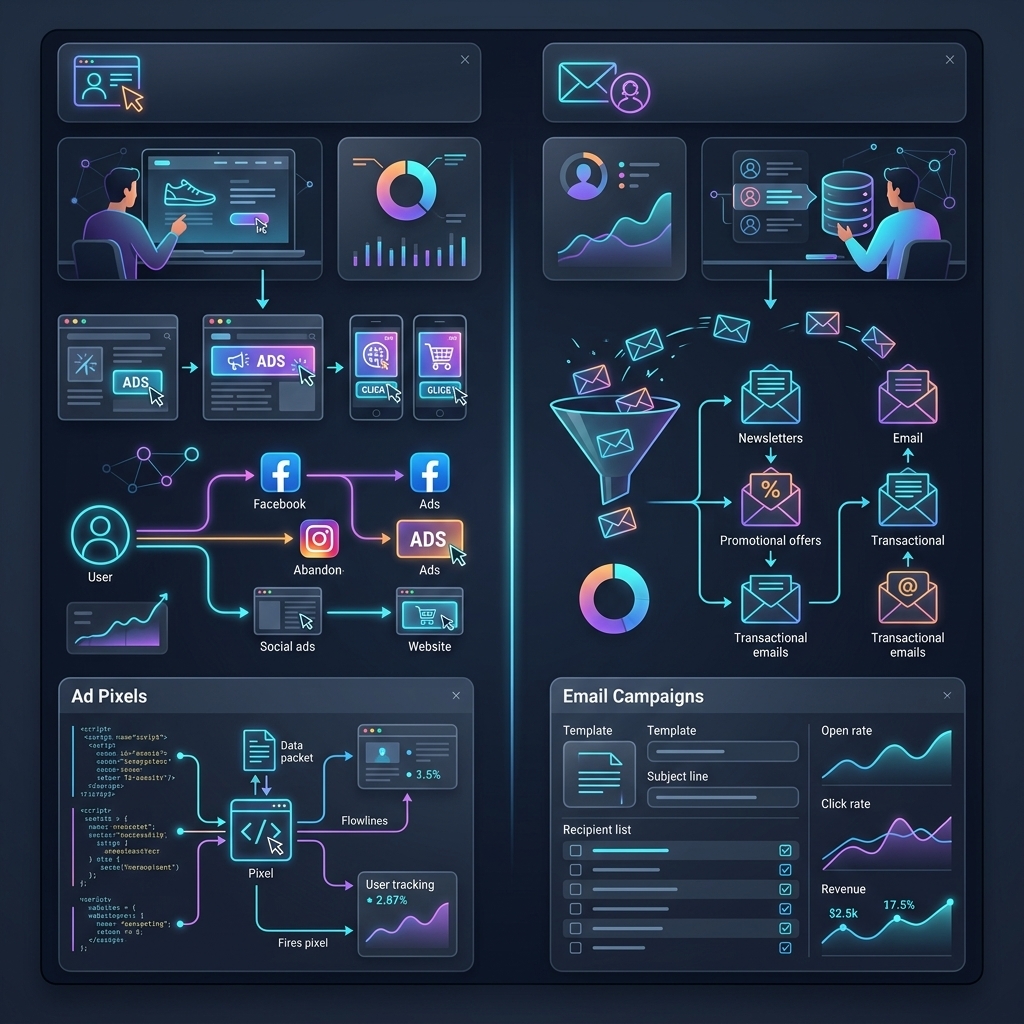
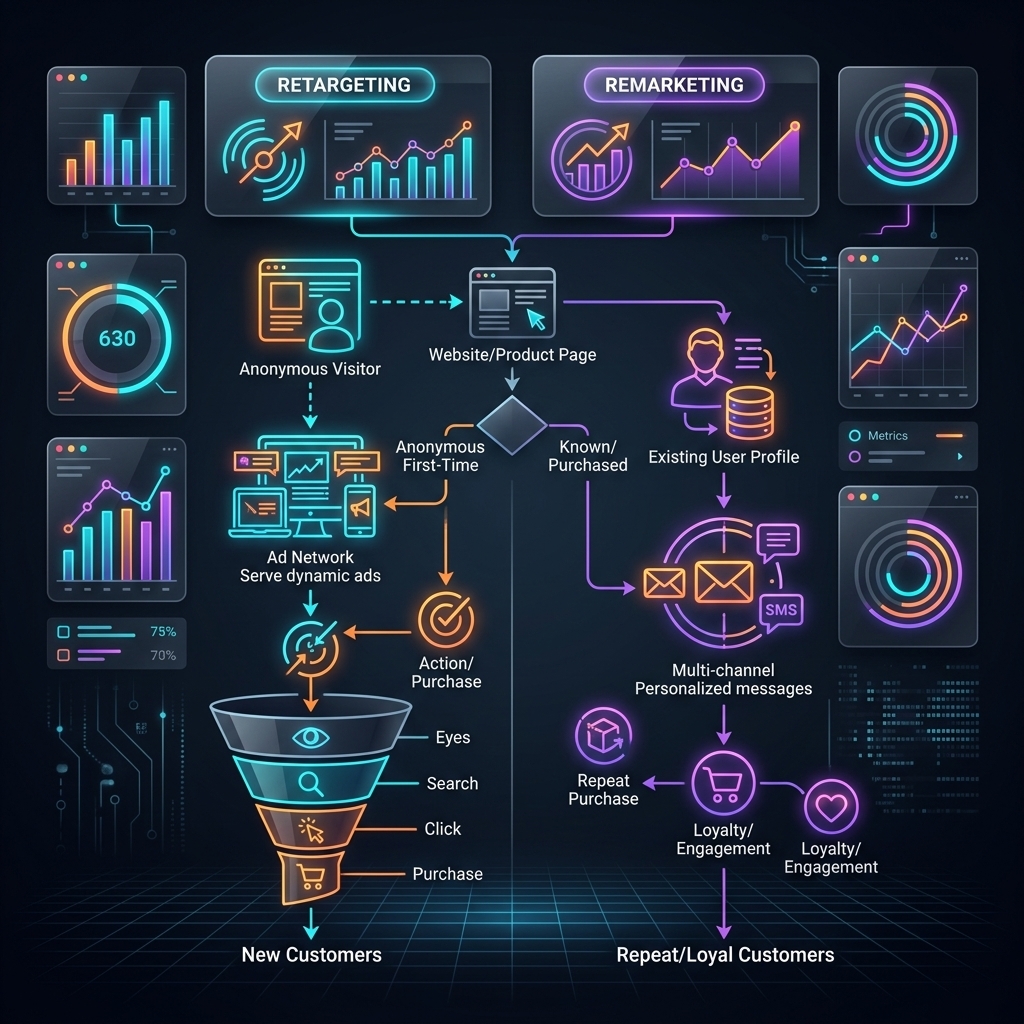
Retargeting serves ads to anonymous website visitors using tracking pixels. Remarketing sends emails to known contacts using CRM data. The terms are used interchangeably in practice — Google even calls its ad-based retargeting “remarketing” — but the technical distinction matters for campaign planning.
Retargeting vs Remarketing Comparison
| Aspect | Retargeting | Remarketing |
|---|---|---|
| Channel | Display ads, social ads | Email, SMS |
| Target Audience | Anonymous site visitors | Known contacts (email on file) |
| Data Source | Tracking pixels, cookies, device IDs | Email lists, CRM databases |
| Method | Pixel fires on visit, ads follow user | CRM triggers email sequence |
| Goal | Bring back anonymous visitors | Re-engage known customers |
| Cost Model | CPM / CPC (ad spend) | Email platform fee (flat/tiered) |
| Tools | Google Display Network, Facebook Custom Audiences, TikTok | Klaviyo, Mailchimp, HubSpot, ActiveCampaign |
| Conversion Impact | Recovers 2-5% of abandoned visitors | Recovers 10-15% of cart abandoners |
What Is Retargeting
Retargeting uses a small piece of code — a tracking pixel — placed on your website. When someone visits your site without converting, the pixel drops a cookie in their browser. That cookie lets ad platforms identify the visitor and serve them targeted ads across other websites and social platforms.
How the process works:
- Visitor lands on your product page.
- Tracking pixel fires and records the visit.
- Visitor leaves without purchasing.
- Your ads appear on websites, social feeds, and apps they browse afterward.
- Visitor clicks the ad and returns to complete the purchase.
Standard retargeting shows the same ad to all past visitors. Dynamic retargeting shows the specific products a visitor viewed — this generates higher conversion rates because the ad matches the user’s demonstrated interest.
The key advantage of retargeting: you reach people who already showed interest. They visited your site. They looked at your products. They just did not buy yet. Running retargeting through an agency ad account ensures these campaigns maintain consistent delivery without the account instability that disrupts audience building.

What Is Remarketing
Remarketing targets people you already know — contacts in your email list or CRM. The user gave you their email address through a purchase, signup, or lead form. You now re-engage them through email sequences, SMS campaigns, or personalized outreach.
Common remarketing campaigns:
- Cart abandonment emails — Triggered when a user adds items to cart but does not complete checkout. Average recovery rate: 10-15%.
- Browse abandonment emails — Sent when a user views products but does not add to cart.
- Win-back campaigns — Re-engage customers who have not purchased in 60-90 days.
- Cross-sell sequences — Recommend related products based on purchase history.
- Re-engagement drips — Reactivate dormant email subscribers.
Remarketing costs less per touchpoint than retargeting because you own the channel. No ad spend required — just your email platform fee. The trade-off is reach. You can only remarket to people who gave you their contact information.

Key Differences Between Retargeting and Remarketing
Audience knowledge. Retargeting reaches anonymous visitors. You know they visited your site, but you do not know who they are. Remarketing reaches identified contacts. You have their email, purchase history, and engagement data.
Data dependency. Retargeting relies on third-party cookies and tracking pixels — both under increasing restriction. Remarketing relies on first-party data you collected directly. First-party data is more reliable and privacy-compliant.
Cost structure. Retargeting costs per impression or click. You pay the ad platform every time your ad is shown or clicked. Remarketing costs a flat monthly fee for your email platform regardless of how many emails you send.
Channel control. Retargeting ads compete in auctions. Your placement and cost depend on competition. Remarketing emails land directly in inboxes. You control the timing, frequency, and content completely.

How Retargeting Works Across Ad Platforms
Google Display Network — Google calls it “remarketing” but it is pixel-based retargeting. Your ads appear across 2M+ websites in Google’s network. Standard and dynamic remarketing lists available. Requires a Google Ads account with the global site tag installed.
Facebook Custom Audiences — Install the Meta pixel on your site. Create Custom Audiences from website visitors segmented by pages viewed, time spent, or actions taken. Serve retargeting ads across Facebook, Instagram, Messenger, and Audience Network.
TikTok — TikTok Pixel tracks website events. Create retargeting audiences based on page views, add-to-cart actions, or video engagement. Retarget across TikTok’s in-feed and TopView placements.
All three platforms require stable ad accounts for persistent retargeting audiences. An agency ad account from ADShift provides the account trust level needed to maintain audience lists without interruption — critical for retargeting campaigns that build value over weeks and months.

Retargeting in a Cookieless Future
Third-party cookies are disappearing. Chrome has deprecated them. Safari and Firefox blocked them years ago. This directly impacts pixel-based retargeting.
What replaces cookies:
- First-party data collection — Build your own email lists, login systems, and loyalty programs. First-party data is the most reliable retargeting asset going forward.
- Server-side tracking — Move tracking from the browser to your server. Facebook Conversions API and Google Enhanced Conversions send data server-to-server, bypassing browser restrictions.
- Contextual targeting — Target based on page content rather than user history. Less precise than retargeting but not affected by cookie deprecation.
- Google Privacy Sandbox — Topics API and Attribution Reporting API replace cookies with privacy-preserving alternatives. Still evolving.
- Platform-native audiences — Facebook and TikTok engagement audiences (video viewers, page followers) do not rely on cookies. Build retargeting lists from in-platform behavior.
The shift rewards advertisers who invest in first-party data and server-side infrastructure. Agencies running campaigns through verified agency ad accounts get early access to these tools and priority support during platform transitions.

When to Use Retargeting vs Remarketing
Use retargeting when:
- Most of your traffic is anonymous (no email capture).
- You need to recover visitors from high-traffic pages.
- Your product is visual and benefits from dynamic ads.
- You want to build awareness with people who showed initial interest.
Use remarketing when:
- You have a large email list or CRM database.
- Cart abandonment is a significant revenue leak.
- Your sales cycle involves multiple touchpoints.
- You want to cross-sell or upsell existing customers.
Use both when:
- You want full-funnel coverage. Retarget anonymous visitors with ads. Remarket to known contacts with email. The combination recovers revenue at both stages.
- Your business captures emails from some visitors but not all. Retargeting catches what remarketing misses.
The decision is not either/or. The strongest performance marketing strategies layer retargeting ads on top of remarketing emails to maximize conversion recovery across the entire customer journey.
FAQ
Does Google use “remarketing” or “retargeting”?
Google uses the term “remarketing” for its pixel-based ad retargeting features. This is a naming convention choice — Google’s remarketing lists are technically retargeting. The industry standard is to call ad-based follow-up “retargeting” and email-based follow-up “remarketing.”
Is retargeting still effective without third-party cookies?
Yes, but the methods are changing. Server-side tracking (Facebook CAPI, Google Enhanced Conversions), first-party data audiences, and platform-native engagement audiences all work without third-party cookies. Advertisers who adapt their tracking infrastructure maintain retargeting effectiveness.
What is dynamic retargeting?
Dynamic retargeting shows users the specific products they viewed on your website. Instead of a generic brand ad, the user sees the exact shoe or software plan they looked at. Dynamic retargeting consistently outperforms standard retargeting in conversion rate and ROAS.
How long should retargeting audiences last?
Standard practice is 30-day windows for most products. High-consideration purchases (B2B, luxury, real estate) benefit from 60-90 day windows. Short purchase cycles (food delivery, fast fashion) work best with 7-14 day windows. Test and adjust based on your sales cycle length.
Run retargeting campaigns without account disruptions — rent a verified agency ad account from ADShift for stable, long-running audience delivery. Explore agency ad accounts.