
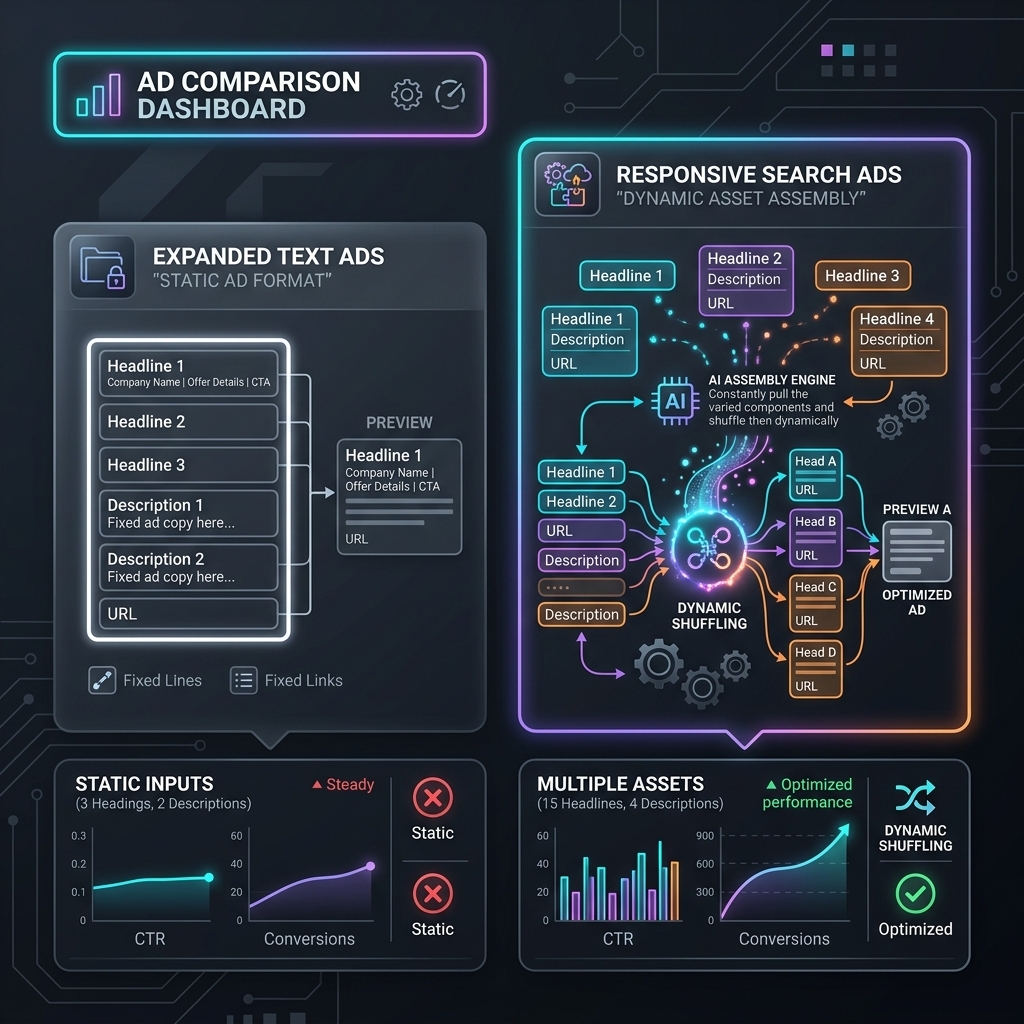
Expanded text ads (ETAs) gave advertisers full control over three headlines and two descriptions. Google sunset that format on June 30, 2022. Responsive search ads (RSAs) are now the only option for new search campaigns, accepting up to 15 headlines and 4 descriptions that Google’s machine learning auto-combines for each auction.
If you are still running legacy ETAs or transitioning to RSAs, the comparison below covers what changed and how to maintain control.
ETA vs RSA Comparison
| Feature | Expanded Text Ads (ETAs) | Responsive Search Ads (RSAs) |
|---|---|---|
| Headlines | 3 (static, you control order) | Up to 15 (Google auto-combines) |
| Descriptions | 2 (static) | Up to 4 (Google auto-combines) |
| Control Level | Full control over messaging | Partial — Google decides combinations |
| Google Status | Sunset June 30, 2022 | Default and only option for new campaigns |
| Performance | Baseline | 5-15% more clicks (Google data) |
| Optimization | Manual A/B testing required | ML auto-optimizes combinations |
| Pin Feature | N/A | Pin headlines/descriptions to positions |
| Ad Strength Score | N/A | Good/Excellent/Poor rating |
What Were Expanded Text Ads
ETAs launched in 2016 as Google’s standard search ad format. Each ETA contained exactly 3 headlines (30 characters each) and 2 descriptions (90 characters each). The advertiser wrote every line and controlled the exact order users saw them.
This static format made A/B testing straightforward. You wrote version A, wrote version B, split traffic, and picked the winner. The tradeoff was manual effort — testing 10 headline variations required creating 10 separate ads.
ETAs still serve in campaigns where they were created before June 2022. You can pause or delete them, but you cannot create new ones or duplicate existing ones into new ad groups.

What Are Responsive Search Ads
RSAs accept up to 15 headlines and 4 descriptions. Google’s machine learning tests thousands of combinations across different queries, devices, and user signals to find the highest-performing mix for each auction.
The system learns over time. An RSA with 10 headlines and 3 descriptions can generate over 43,000 unique combinations. Google narrows to top performers as data accumulates.
Ad strength is a built-in score rating your RSA setup. Providing 8-10 unique headlines and 3-4 descriptions typically earns a “Good” or “Excellent” rating, which correlates with better delivery.

Why Google Deprecated ETAs
Google’s decision came down to scale and signals. Machine learning optimization requires volume — more headline variations, more description options, more auctions to test across. ETAs limited that to 3 fixed headlines per ad.
RSAs let Google test at a scale no advertiser could match manually. The system factors in query context, device type, location, time of day, and user history when selecting which headline combination to show. A static ETA cannot adapt to those signals.
For advertisers managing campaigns through an agency ad account, this shift means optimization now happens at the asset level (individual headlines and descriptions) rather than the ad level.

RSA Performance vs ETA
Google’s own data shows RSAs deliver 5-15% more clicks than ETAs on average. That lift comes from two sources: better query matching and broader signal testing.
RSAs match more search queries because Google can combine headlines to fit a wider range of user intent. An ETA with the headline “Best Running Shoes” only shows for queries matching that phrase. An RSA with 15 headline variations can surface a more relevant combination for “lightweight trail shoes” or “marathon training shoes” from the same ad.
The performance gap widens with sufficient data. RSAs in campaigns spending $50/day or more typically outperform RSAs in low-budget campaigns because the ML needs volume to optimize.
One caveat: RSAs can underperform ETAs when the advertiser provides low-quality or redundant headlines. Writing 15 variations of the same message gives Google nothing meaningful to test.

How to Maximize RSA Control
The pin feature is the key tool for advertisers who want ETA-like control within the RSA format. Pinning locks a specific headline or description to a specific position.
Pin strategically, not aggressively. Pinning all three headline positions defeats the purpose of RSAs and limits Google’s optimization. Pin only when brand compliance or legal requirements demand it — for example, pinning your brand name to headline position 1.
Best practices for RSA optimization:
- Write 8-10 unique headlines covering different angles (features, benefits, urgency, social proof)
- Provide 3-4 descriptions that work independently with any headline combination
- Pin 1-2 headlines maximum — leave the rest flexible
- Include your primary keyword in at least 2-3 headlines
- Monitor the “combinations” report to see which pairings Google favors
- Replace low-performing assets every 30-60 days
Running RSAs through a verified agency ad account gives campaigns the account history and trust signals that improve delivery from day one. If you need a stable Google Ads account for your RSA campaigns, rent a Google Ads account from ADShift.

FAQ
Can I still run my existing expanded text ads?
Yes. ETAs created before June 30, 2022 continue to serve. You can pause or delete them but cannot create new ETAs or copy them to new ad groups.
Do RSAs always outperform ETAs?
Not always. RSAs with poorly written or redundant headlines can underperform a well-crafted ETA. The 5-15% lift requires diverse, high-quality headline assets.
How many headlines should I write for an RSA?
Google recommends at least 8-10 unique headlines and 3-4 descriptions. This gives the ML enough variation to optimize without diluting message quality.
Does pinning headlines hurt RSA performance?
Pinning 1-2 headlines has minimal impact. Pinning all positions significantly limits optimization and negates the RSA advantage. Use pinning only for brand or compliance requirements.
Should I delete my old ETAs now?
Not necessarily. If an ETA still performs well, let it run alongside your RSAs. Google will naturally shift spend toward the higher performer. Deleting a strong ETA removes a data point from your agency ad account history.