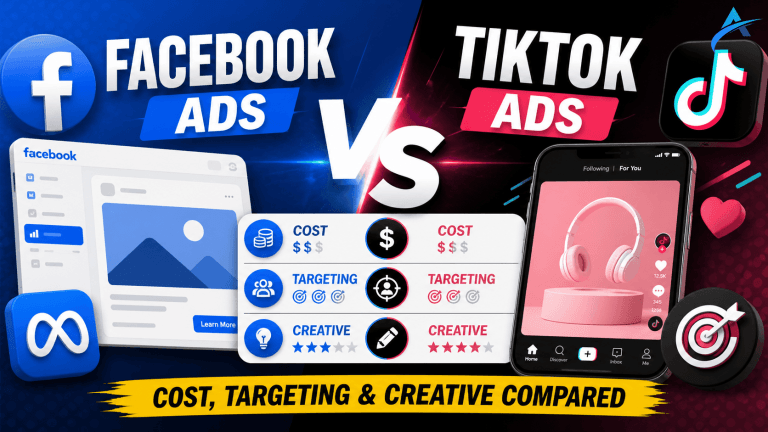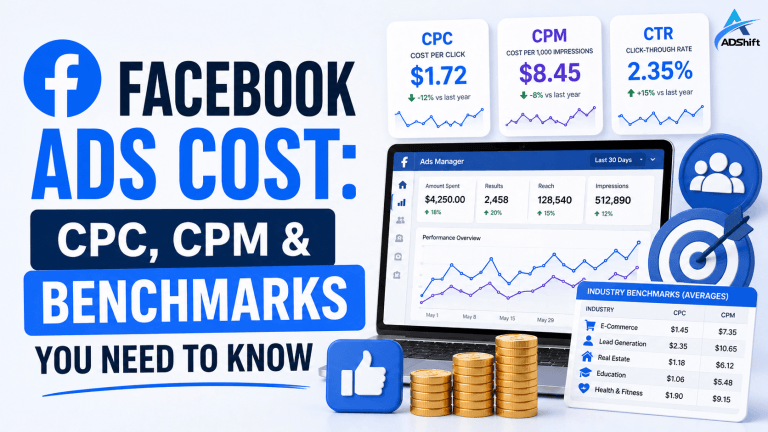

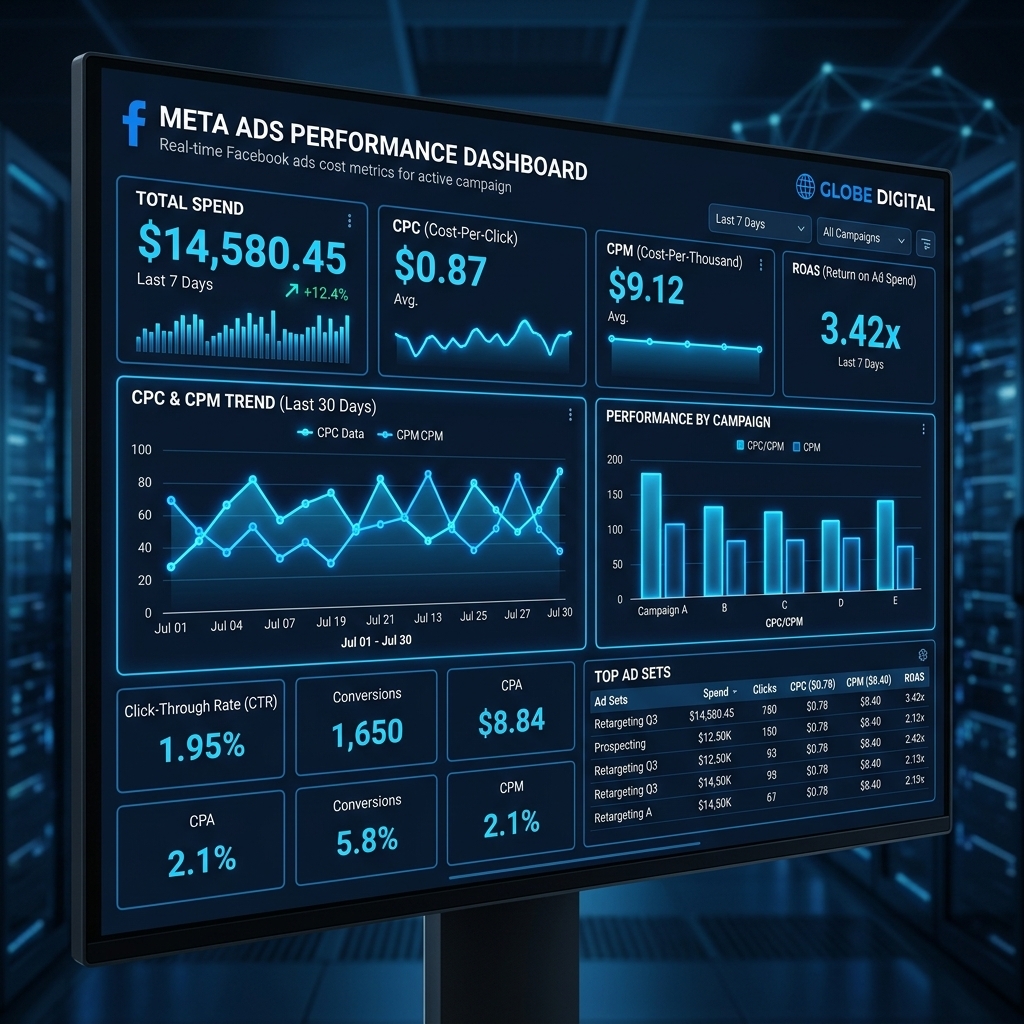
Facebook ads cost $0.44-$1.92 per click, $8.99-$16.06 per 1,000 impressions, and $5.83-$27.66 per lead in 2026. Your actual cost depends on your audience, placement, campaign objective, and time of year.
These numbers represent cross-industry averages. Your specific costs will vary based on competition in your niche and how well you build your campaigns.
Facebook Ads Cost Overview in 2026
Here are the current benchmark ranges across key metrics:
| Metric | Low Range | High Range | Median |
|---|---|---|---|
| Cost Per Click (CPC) | $0.44 | $1.92 | $0.97 |
| Cost Per 1,000 Impressions (CPM) | $8.99 | $16.06 | $12.07 |
| Cost Per Lead (CPL) | $5.83 | $27.66 | $13.50 |
| Cost Per 1,000 People Reached | $6.50 | $12.00 | $8.90 |
These figures come from aggregated campaign data across e-commerce, SaaS, local services, and direct-to-consumer brands. Industries like finance and insurance trend toward the high end. Apparel, food, and entertainment sit at the low end.
Compared to Google Ads pricing, Facebook delivers significantly cheaper clicks — but the traffic behaves differently. Facebook users are browsing, not searching. Conversion rates tend to run 1-3% versus 3-8% on Google Search, which means cost-per-acquisition can be comparable despite the lower CPC.
How to Set Your Facebook Advertising Budget
Facebook offers two budget structures: daily budget and lifetime budget. Each works at either the campaign level or the ad set level.
Daily vs Lifetime Budget
Daily budget tells Facebook to spend approximately that amount each day. Facebook may exceed it by up to 25% on high-opportunity days, but your weekly average stays on target. Minimum daily budget is $5 for most objectives.
Lifetime budget sets a total spend for the campaign’s duration. Facebook distributes spend across the schedule automatically, spending more on high-performance days and less on slower ones. This works best for campaigns with fixed end dates — product launches, seasonal promotions, or event-driven advertising.
Campaign Budget Optimization (CBO)
With CBO enabled, you set one budget at the campaign level and Facebook allocates it across ad sets based on performance. This eliminates manual budget shifting between audiences. CBO requires at least 2 ad sets to function and works best with 3-5 ad sets running simultaneously.
Minimum Thresholds
- Minimum daily budget: $5 per ad set for impressions, clicks, or video views
- Minimum for conversion optimization: $10-$20 per day (Facebook needs ~50 conversions per week to optimize)
- Minimum for lead generation: $15-$30 per day to exit the learning phase within 7 days
Setting budgets below these thresholds means your campaigns never collect enough data to optimize. The learning phase requires approximately 50 optimization events per week per ad set. At a $10 CPL, that means $500/week ($71/day) to fully optimize a lead generation campaign.
What Affects How Much Facebook Ads Cost
Seven factors determine your facebook advertising costs:
Audience Size and Competition
Targeting 500,000 people costs less per impression than targeting 50,000 people in the same demographic. Narrow audiences create more auction competition per user. Broad targeting gives Facebook’s algorithm room to find cheap conversions.
Placement Selection
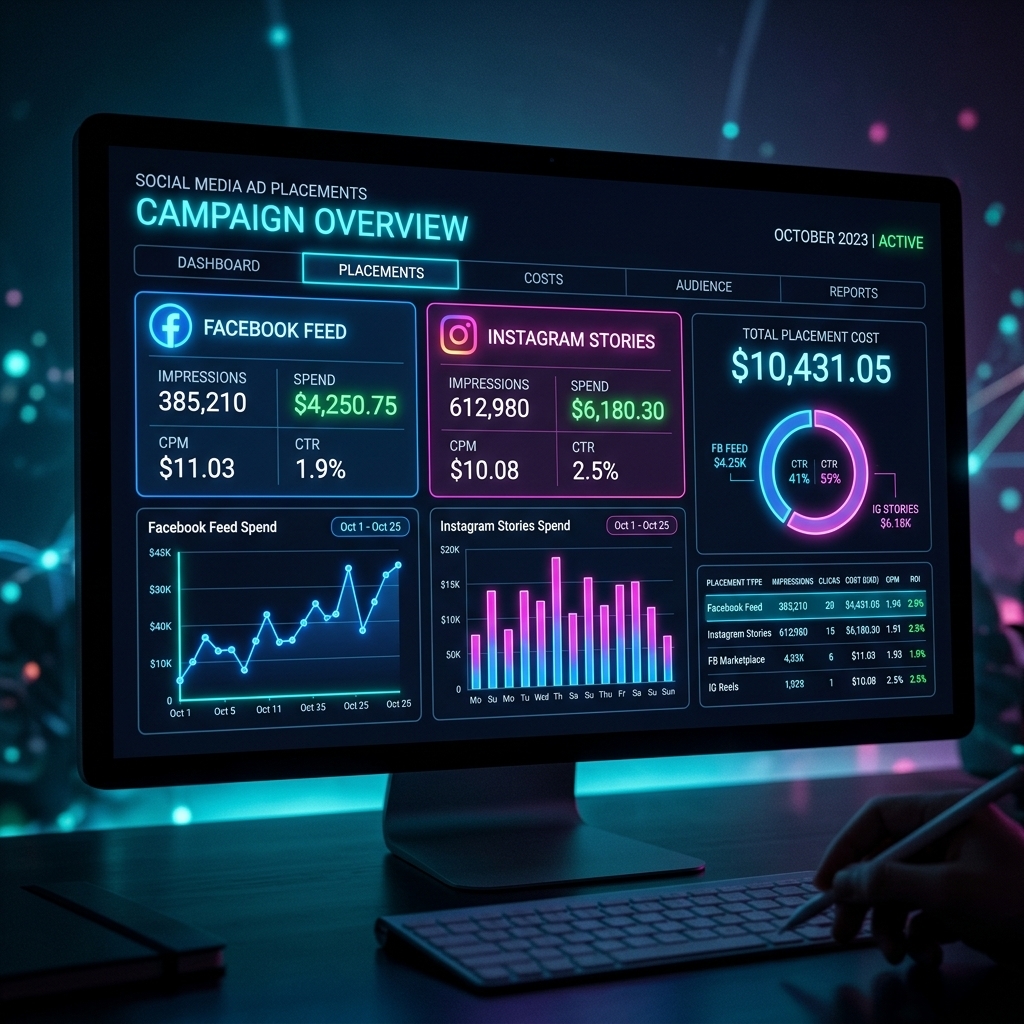
| Placement | Avg CPM | Avg CPC |
|---|---|---|
| Facebook Feed | $12.00 – $16.00 | $0.80 – $1.50 |
| Instagram Feed | $10.00 – $14.00 | $0.70 – $1.40 |
| Instagram Stories | $8.00 – $12.00 | $0.50 – $1.20 |
| Facebook Reels | $6.00 – $10.00 | $0.40 – $0.90 |
| Audience Network | $3.00 – $6.00 | $0.20 – $0.50 |
Advantage+ placements (formerly automatic placements) let Meta distribute your budget across all placements based on performance. This typically reduces CPM by 10-20% compared to manual placement selection because it accesses cheaper inventory when feed costs spike.
Campaign Objective
Awareness objectives cost the least per impression. Traffic objectives cost more per click. Conversion objectives cost the most per action — but deliver the highest-value results. Facebook’s auction prioritizes showing your ad to users most likely to complete your chosen objective, which changes who you compete against.
Time of Year
Q4 (October-December) inflates Facebook CPMs by 30-50% due to holiday advertising pressure. Black Friday week can spike CPMs to 2-3x normal levels. January and February offer the cheapest inventory as advertisers pull back post-holiday.
Ad Quality and Relevance
Meta assigns a quality ranking, engagement ranking, and conversion rate ranking to each ad. Ads with above-average rankings across all three receive auction preference — meaning lower CPMs and CPCs. Poor-quality ads get penalized with higher costs or restricted delivery.
Industry Vertical
Finance, insurance, and legal advertisers pay 2-3x the average CPM due to high customer lifetime values driving aggressive bidding. E-commerce and entertainment brands pay below average. Your industry determines your competitive baseline.
Account History
An agency ad account with established spend history and positive performance signals receives better auction treatment than a brand-new personal ad account. Meta’s system factors in account reliability, payment history, and policy compliance when determining ad delivery priority.
Facebook Ads Cost by Campaign Objective
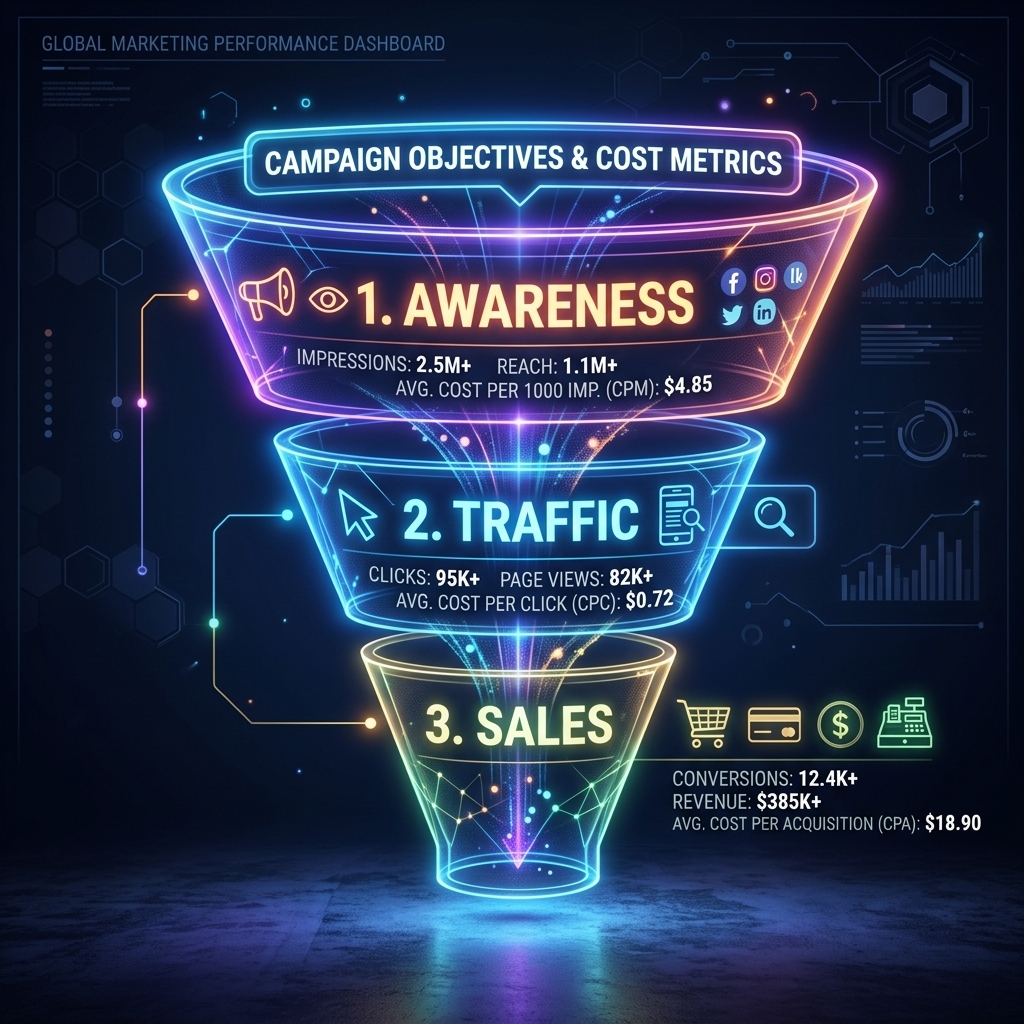
Each objective carries a different cost structure because Facebook optimizes delivery to different user pools:
| Objective | Typical CPC | Typical CPM | Typical Cost Per Result |
|---|---|---|---|
| Awareness | N/A | $5.00 – $8.00 | $0.005 – $0.01 per impression |
| Traffic | $0.40 – $1.20 | $8.00 – $14.00 | $0.40 – $1.20 per click |
| Engagement | $0.10 – $0.50 | $6.00 – $10.00 | $0.02 – $0.10 per engagement |
| Leads | $1.00 – $3.00 | $12.00 – $20.00 | $5.83 – $27.66 per lead |
| Sales/Conversions | $0.80 – $2.50 | $10.00 – $18.00 | $15 – $80 per purchase |
| App Installs | $1.50 – $4.00 | $14.00 – $22.00 | $2.00 – $7.00 per install |
Choosing the wrong objective is the most expensive mistake in Facebook advertising. Running a Traffic campaign when you want leads means Facebook finds clickers, not converters. Those cheap clicks never turn into customers. Match your objective to your actual business goal, not the one with the lowest CPC.
How Much Should You Spend on Facebook Ads
Budget ranges by business stage:
Small Business ($200-$1,500/month)
Enough to test 2-3 audiences with 2-3 ad creatives each. Focus on one campaign objective. At $500/month, you can reach approximately 40,000-60,000 people and generate 250-500 clicks. This budget works for local businesses, solo practitioners, and early-stage e-commerce stores.
Allocate 60% to your best-performing campaign and 40% to testing new audiences and creatives.
Mid-Size Business ($1,500-$10,000/month)
At this level, you can run multiple campaign objectives simultaneously — retargeting warm audiences while prospecting cold audiences. A $5,000/month budget supports a full-funnel approach: awareness at top, traffic in middle, conversions at bottom.
Expect 2,500-10,000 clicks per month and enough conversion data to let Facebook optimize effectively.
Running campaigns through an agency ad account at this spend level provides stability. Account restrictions or payment issues on a personal account can halt campaigns for days — and restarting from zero destroys your optimization data.
Enterprise ($10,000-$100,000+/month)
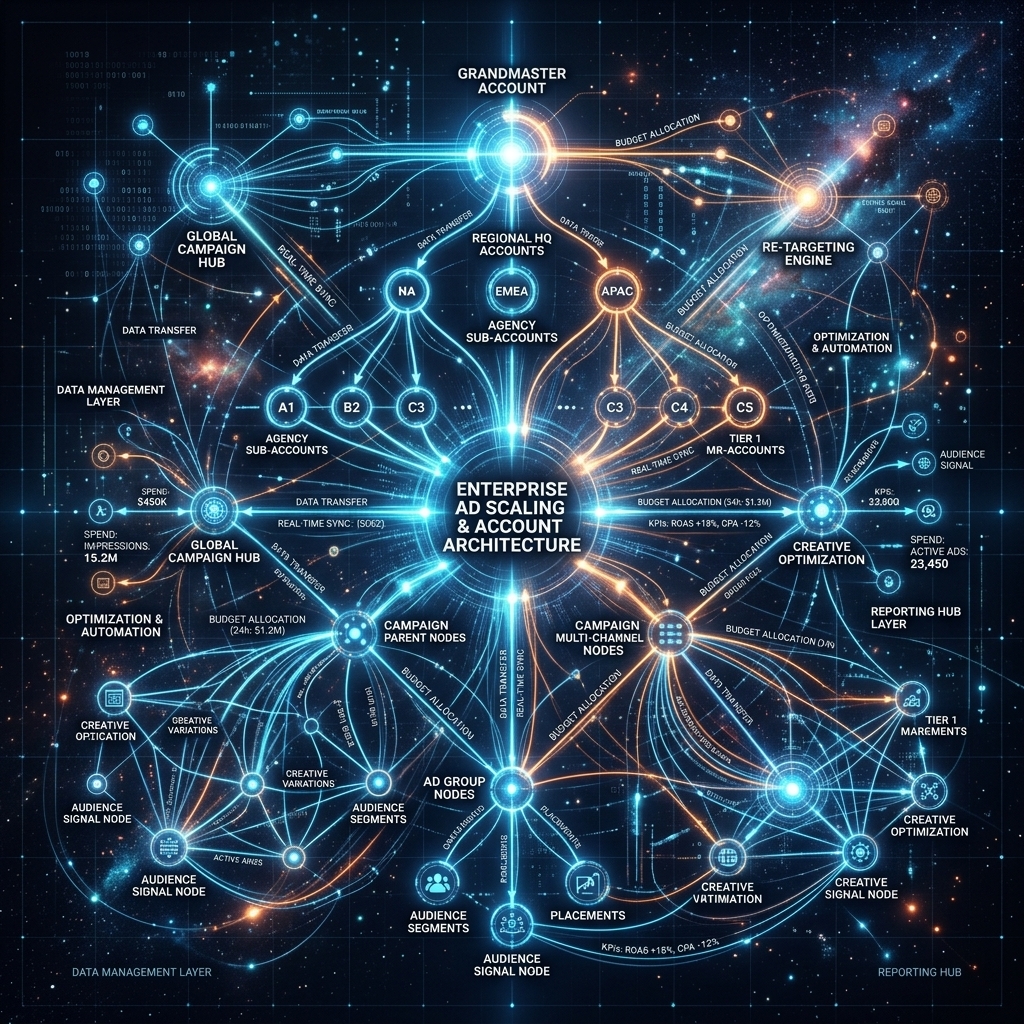
Enterprise budgets require structured campaign architecture: dedicated budgets per audience segment, creative refresh cycles every 2-3 weeks, and systematic testing frameworks. At $50,000/month, creative fatigue becomes the primary cost driver — not audience or bidding.
Brands at this level typically maintain multiple agency ad accounts to segment spend by product line, geography, or funnel stage. This prevents one underperforming campaign from contaminating the account-level signals that Meta uses for optimization.
How to Lower Your Facebook Advertising Costs
Six strategies that reduce cost to advertise on facebook without sacrificing results:
Expand Your Audience
Counter-intuitive but effective: broader audiences often deliver lower CPMs because Facebook has more users to choose from. Instead of targeting a 200,000-person lookalike at 1%, test a 2-3% lookalike of 1-2 million people. Let Meta’s algorithm find the converters within the larger pool.
Test Creative Aggressively
Creative is the single biggest cost lever on Facebook. One winning ad can deliver CPCs 60-70% below account average. Run 3-5 creative variations per ad set. Kill anything with below-average engagement within 3 days. Scale winners.
Static images, videos, and carousel ads perform differently by industry. Test all three formats before committing budget.
Use Advantage+ Shopping Campaigns
For e-commerce, Advantage+ campaigns use Meta’s machine learning to automate audience targeting and placement selection. Early data shows 15-25% lower CPA compared to manual campaigns. The trade-off is reduced control over who sees your ads.

Implement Proper Conversion Tracking
Without the Meta Pixel and Conversions API installed correctly, Facebook cannot optimize for real business results. Missing conversion data forces the algorithm to optimize for proxy metrics like clicks — which costs more per actual customer acquired.
Verify your pixel fires correctly on all conversion events. Use the Conversions API as a backup signal for iOS 14.5+ users who opt out of tracking.
Retarget Before Prospecting
Retargeting audiences (website visitors, email lists, video viewers) convert at 3-5x the rate of cold audiences. Allocate 20-30% of budget to retargeting. The CPC may be similar, but the conversion rate difference means dramatically lower cost per acquisition.
Consolidate Ad Sets
Running too many ad sets fragments your budget and prevents any single ad set from exiting the learning phase. Combine similar audiences into fewer, larger ad sets. Facebook recommends no more than 5 active ad sets per campaign for optimal learning.

FAQ
Is $500 enough for Facebook ads?
$500/month gives you roughly $16/day — enough for a single campaign with 2-3 ad sets. You will generate approximately 250-500 clicks and enough data to identify winning audiences and creatives. It is a workable testing budget for small businesses, but not enough to scale.
What is the minimum budget for Facebook ads?
Facebook’s minimum is $5/day per ad set for most objectives. For conversion-optimized campaigns, plan $20-$30/day minimum to exit the learning phase. Spending below $10/day on conversion campaigns means Facebook never collects enough data to optimize — you end up paying more per result than you would with a higher budget.
How much does it cost for 1,000 impressions on Facebook?
The average CPM (cost per 1,000 impressions) ranges from $8.99 to $16.06 in 2026. Your actual CPM depends on audience competitiveness, ad quality, and time of year. Broad targeting in off-peak months can deliver CPMs as low as $5-$6.
Are Facebook ads cheaper than Google ads?
Facebook ads cost $0.44-$1.92 per click versus $4.22-$5.26 per click on Google Search. On a CPC basis, Facebook is 3-5x cheaper. On a cost-per-customer basis, they are often comparable because Google Search traffic converts at higher rates. Choose based on where your customers are in the buying process, not the CPC alone.
How much should a small business spend on Facebook ads?
Start at $300-$500/month to test and learn. Once you identify profitable audiences and creatives, scale to $1,000-$1,500/month. The goal is not to find the minimum — it is to find the budget where each additional dollar still produces positive ROI.

Account disruptions are the hidden cost of Facebook advertising. Restricted accounts, disabled payment methods, and verification delays waste budget and destroy optimization data. ADShift provides stable, verified agency ad accounts for Meta advertising so your campaigns run without interruption.
Read next: Google Ads Pricing: How the Auction Model Sets Your Ad Costs