
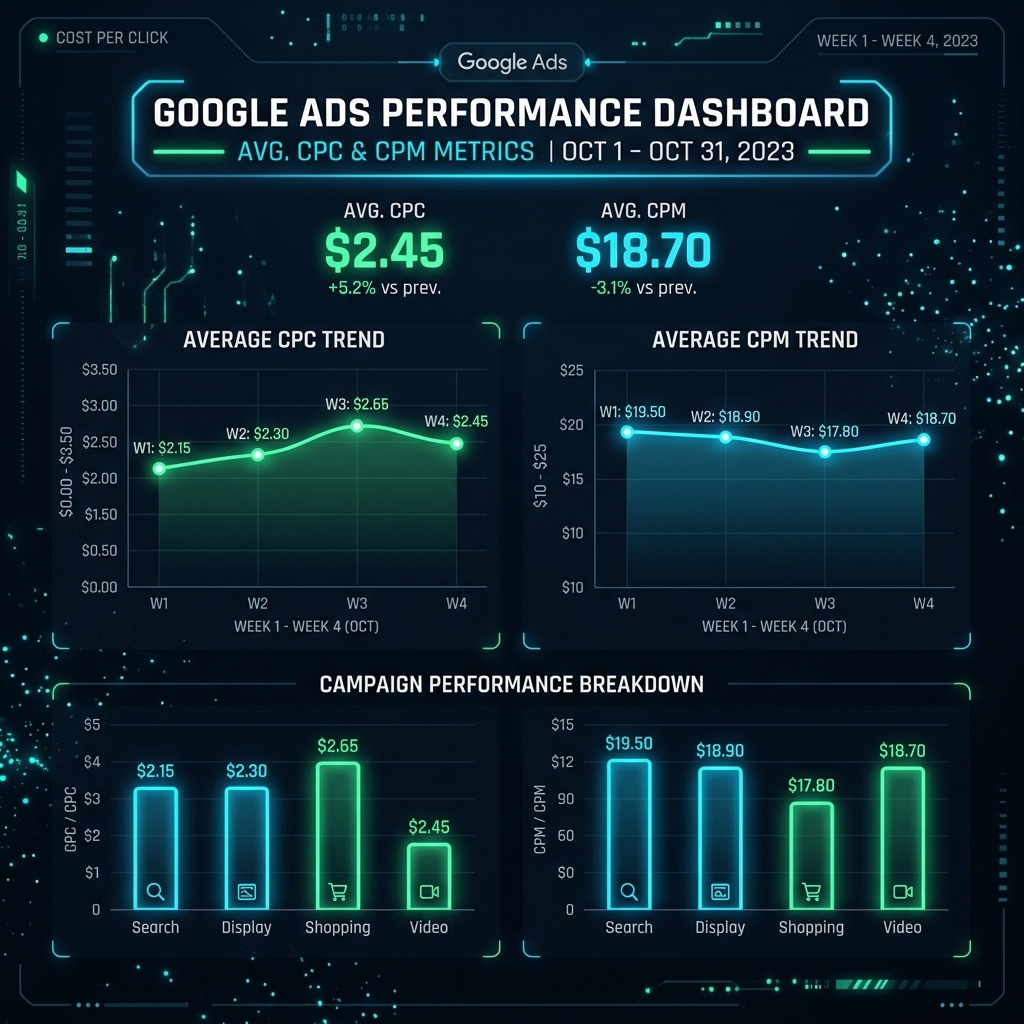
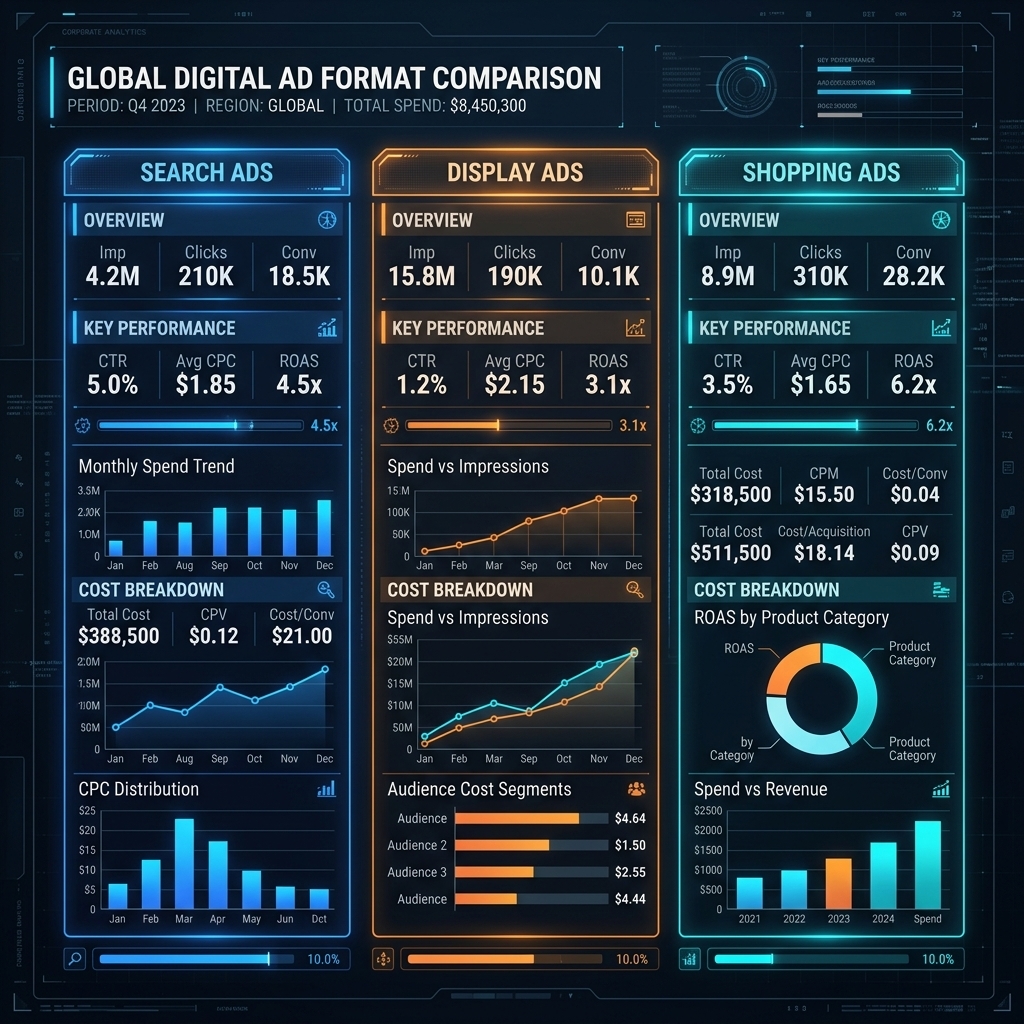
Google Ads cost $4.22-$5.26 per click on Search, $0.63 per click on Display, and $0.66 per click on Shopping in 2026. Most businesses spend between $1,000 and $10,000 per month, with a typical starting daily budget of $20-$50.
These are cross-industry averages. Your actual costs depend on your industry, keywords, geographic targeting, and account quality. Below is the full breakdown.
Average Google Ads Cost in 2026
The quick reference numbers:
| Metric | Search | Display | Shopping |
|---|---|---|---|
| Average CPC | $4.22 – $5.26 | $0.63 | $0.66 |
| Average CPM | $30 – $50 | $0.50 – $4.00 | N/A |
| Typical Monthly Spend | $1,000 – $10,000 | $500 – $5,000 | $1,000 – $15,000 |
| Recommended Daily Budget | $20 – $50 | $10 – $30 | $20 – $50 |
Search CPC has increased approximately 8-12% year-over-year since 2023, driven by rising advertiser competition and Google’s shift toward AI-powered bidding that maximizes auction revenue. Display and Shopping CPCs have remained relatively stable.
The gap between Search and Display CPC reflects intent value. A Search click represents someone actively looking for your product. A Display click is an interruption in someone’s browsing. That intent difference is worth the 6-8x price premium for most advertisers.
Google Ads Cost by Ad Format
Each Google Ads format serves a different purpose and carries a different cost structure:
| Ad Format | Avg CPC | Avg CPM | Best Use Case | Conversion Rate |
|---|---|---|---|---|
| Search Ads | $4.22 – $5.26 | $30 – $50 | Direct response, lead gen | 3.5% – 8% |
| Display Ads | $0.63 | $0.50 – $4.00 | Remarketing, awareness | 0.5% – 1.5% |
| Shopping Ads | $0.66 | N/A | E-commerce products | 1.5% – 3% |
| YouTube Ads | $0.01 – $0.30 (CPV) | $4.00 – $10.00 | Video awareness, consideration | 0.5% – 2% |
| Performance Max | Blended | Blended | Cross-channel automated | Varies |
| Discovery/Demand Gen | $0.50 – $1.50 | $5.00 – $12.00 | Mid-funnel engagement | 1% – 2.5% |
Search Ads command the highest CPC because they capture high-intent traffic. A user searching “buy standing desk” is closer to a purchase than someone scrolling through YouTube. That proximity to conversion justifies the higher click cost.
Shopping Ads deliver strong ROI for e-commerce despite lower conversion rates than Search because they pre-qualify buyers. Users see the product image, price, and store name before clicking — meaning clicks carry higher purchase intent than a generic text ad.
Performance Max blends all formats into one automated campaign. You cannot control CPC per format within PMax. Google allocates your budget across Search, Display, Shopping, YouTube, Gmail, and Maps based on where it predicts conversions. PMax accounts with strong historical signals — like those running through an agency ad account with cross-industry data — tend to exit the learning phase faster and deliver lower CPAs.
Google Ads Cost by Industry
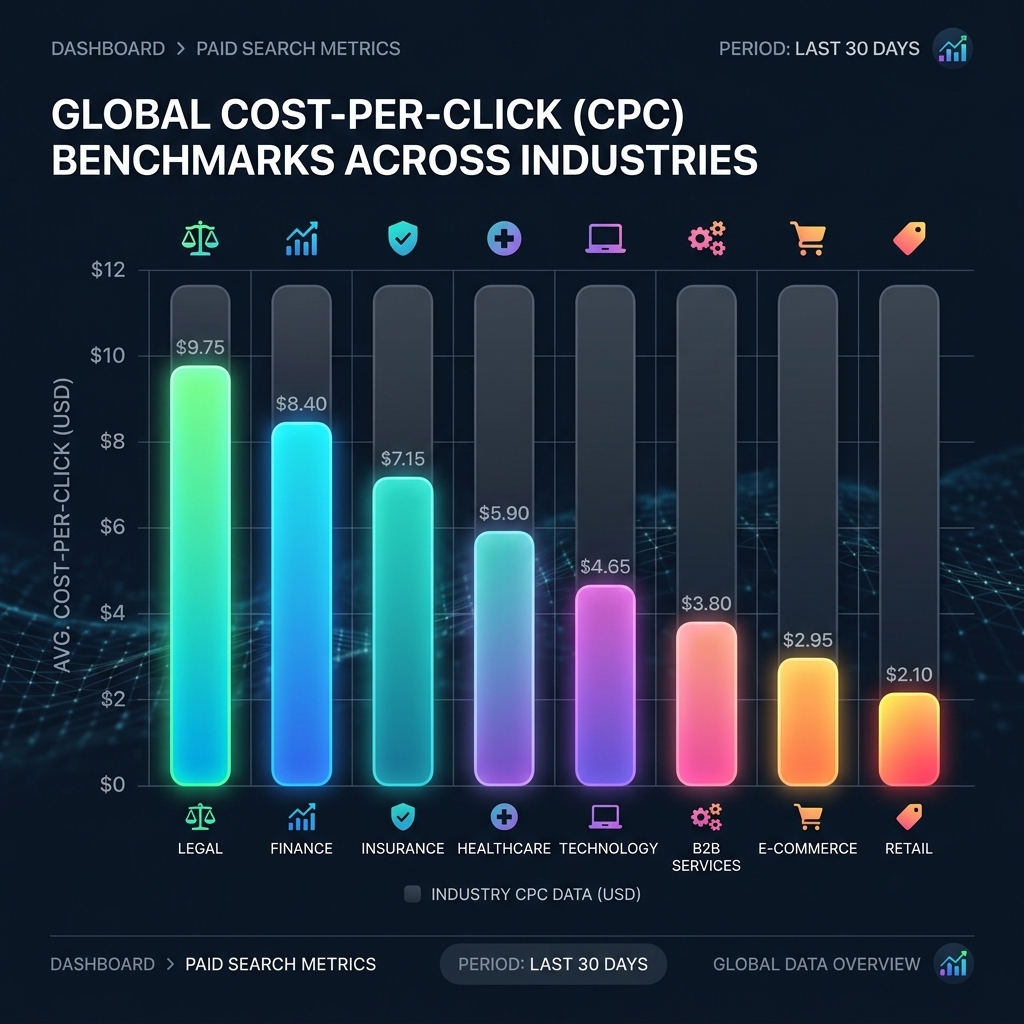
Industry is the single largest factor in google ads cost per click. Here are 2026 benchmarks for the 10 most-searched industries:
| Industry | Avg CPC (Search) | Avg CPC (Display) | Competition Level |
|---|---|---|---|
| Legal Services | $8.67 – $12.35 | $0.72 | Extreme |
| Insurance | $7.90 – $11.20 | $0.68 | Extreme |
| Finance & Banking | $6.40 – $9.80 | $0.65 | Very High |
| Home Services | $5.50 – $8.10 | $0.60 | High |
| Health & Medical | $4.80 – $7.20 | $0.58 | High |
| B2B / SaaS | $4.50 – $6.80 | $0.55 | High |
| Real Estate | $3.80 – $5.90 | $0.52 | Medium-High |
| Education | $3.20 – $5.10 | $0.48 | Medium |
| E-commerce (General) | $1.80 – $3.50 | $0.45 | Medium |
| Travel & Hospitality | $1.50 – $3.20 | $0.42 | Medium |
Legal and insurance dominate the CPC charts because a single customer can be worth $5,000-$50,000+ in lifetime revenue. Attorneys bidding $12 per click are willing to pay $300-$500 per lead because one signed case covers months of ad spend.
If your industry has high CPCs, the path to profitability is improving conversion rate rather than trying to lower CPC. A 1% improvement in landing page conversion rate has more financial impact than a $0.50 CPC reduction in high-competition verticals.
How Much Should You Budget for Google Ads
Budget ranges by business size and objective:
Small Business: $500-$5,000/month
At $1,000-$2,000/month, a small business can run 1-2 Search campaigns targeting 10-20 keywords. This generates 200-500 clicks per month — enough to test messaging, identify converting keywords, and build account history.
Start with your highest-intent keywords and a daily budget of $30-$50. Running a focused $1,500/month campaign outperforms spreading $1,500 across five campaigns at $300 each. Concentration beats diversification at small budgets.
Mid-Size Business: $5,000-$30,000/month
This budget supports a full-funnel approach: Search for bottom-funnel conversions, Display remarketing for mid-funnel engagement, and YouTube or Demand Gen for top-funnel awareness. A $15,000/month budget typically splits 60% Search, 20% remarketing, 20% prospecting.
At this spend level, automated bidding strategies like Target CPA and Target ROAS become effective because you generate enough conversion data (50+ per month) for Google’s algorithm to optimize.

Enterprise: $30,000-$500,000+/month
Enterprise budgets require dedicated account management, A/B testing infrastructure, and attribution modeling. At $100,000+/month, the primary challenge shifts from generating traffic to maintaining efficiency at scale.
Large advertisers often segment spend across multiple agency ad accounts by product line, region, or business unit. This prevents a poorly performing campaign in one division from degrading the account-level Quality Score that affects all other campaigns.
Hidden Costs of Google Ads
The CPC is not your only cost. Factor these into your google ads budget:
Management Fees
Self-managed accounts cost your time. Effective Google Ads management requires 5-15 hours per month for a small account and 20-40 hours for mid-size accounts. If you hire an agency, expect management fees of 10-20% of ad spend or $500-$2,000/month flat fee.
Landing Page Development
Each campaign needs a dedicated landing page optimized for conversion. Professional landing page design costs $500-$3,000 per page. Template-based builders like Unbounce or Instapage run $99-$299/month. Skipping landing page optimization means paying full CPC for traffic that does not convert.

Conversion Tracking Setup
Proper tracking requires Google Tag Manager, Google Analytics 4, conversion linker tags, and potentially offline conversion imports. Initial setup takes 4-8 hours for a technical marketer. Incorrect tracking leads to wrong optimization signals — the algorithm optimizes for the wrong actions, inflating true cost per customer.
Wasted Spend
The average Google Ads account wastes 20-30% of budget on irrelevant clicks, poor-performing keywords, and unoptimized campaigns. For a $5,000/month account, that is $1,000-$1,500 burned. Weekly optimization — reviewing search terms, adjusting bids, pausing underperformers — reduces waste to under 10%.
Account Restart Costs
When an ad account gets suspended or you start fresh, you lose all historical data. The learning phase on a new account means 2-4 weeks of inflated CPCs while Google calibrates. I have seen accounts where the first month’s CPC ran 40-60% above the stabilized rate. This restart penalty is why established agency ad accounts carry tangible financial value — they skip the expensive learning phase entirely.

How to Control Your Google Ads Costs
Five controls that keep your google ads cost per month predictable:
Set Budget Caps
Google allows daily budget caps at the campaign level. Your actual daily spend may exceed the cap by up to 2x on any given day, but monthly spend will never exceed your daily budget multiplied by 30.4. For a $50/day budget, your maximum monthly charge is $1,520.
Set shared budgets across related campaigns if you want a single monthly cap for an entire initiative.
Choose the Right Bid Strategy
| Bid Strategy | Control Level | Best For | Risk Level |
|---|---|---|---|
| Manual CPC | Full control | New campaigns, testing | Low |
| Enhanced CPC | Mostly controlled | Campaigns with some conversion data | Low-Medium |
| Target CPA | Google controlled | 30+ conversions/month | Medium |
| Maximize Conversions | Google controlled | Accounts with strong data | Medium-High |
| Target ROAS | Google controlled | E-commerce with revenue tracking | Medium |
Start with Manual CPC to understand your baseline costs. Move to Target CPA once you have 30-50 conversions per month. Never start a new campaign on Maximize Conversions — without historical data, Google will spend aggressively to gather signals, which inflates early costs.

Build Negative Keyword Lists
Negative keywords prevent your ads from showing on irrelevant searches. A search term like “free google ads training” should not trigger your ad if you sell a paid service. Build negative keyword lists at the account level and review the Search Terms report weekly.
A strong negative keyword list of 200-500 terms typically saves 15-25% of total ad spend.
Optimize Quality Score
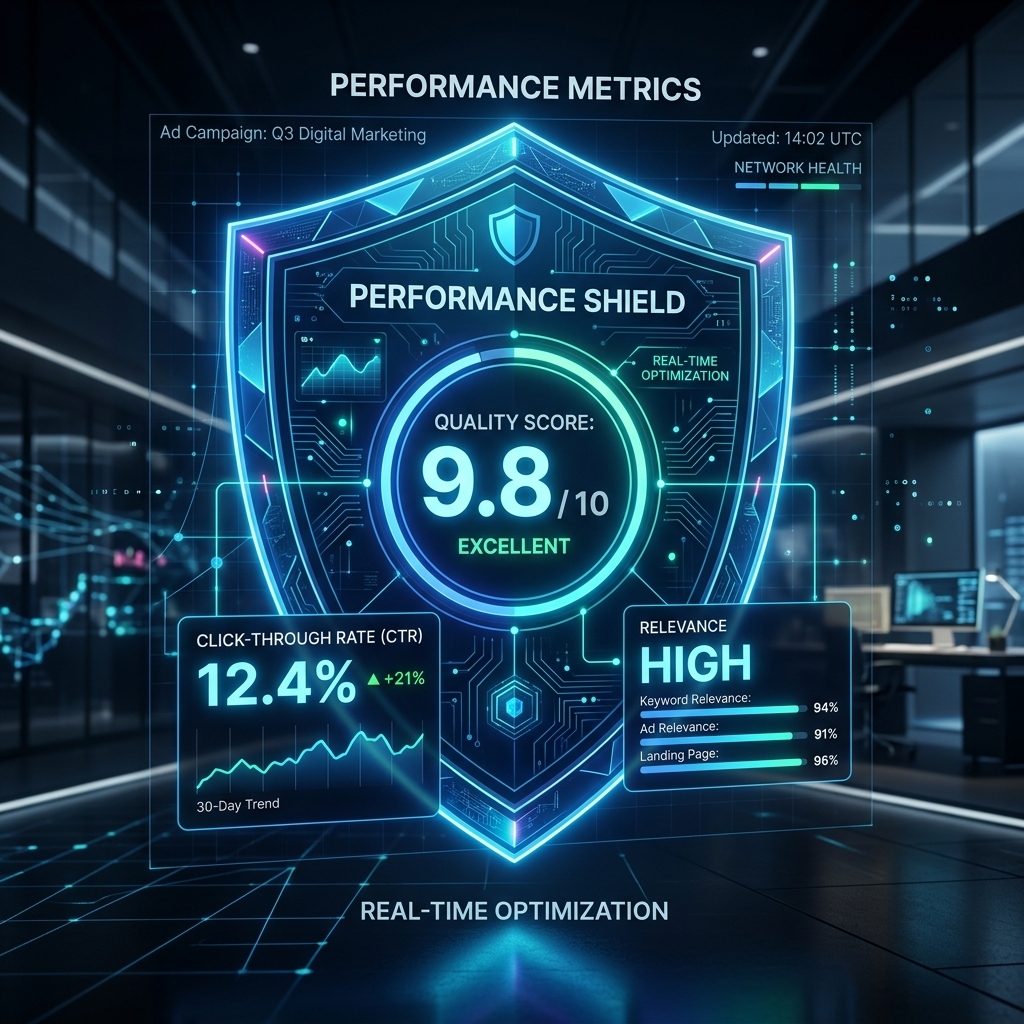
Quality Score directly impacts your CPC. Every point above 5 reduces your cost per click. Every point below 5 increases it. Focus on three components: expected CTR, ad relevance, and landing page experience.
Practical steps: match ad headlines to keyword intent, include the keyword in your display URL, and ensure your landing page loads in under 3 seconds with content that directly addresses the search query.
Schedule Ads Strategically
Run ads only during hours that produce conversions. Pull your campaign data by hour of day and day of week. Identify dead zones — typically late night and early morning — and reduce or pause bids during those windows. This alone can reduce wasted spend by 10-20%.
FAQ
Is $1/day enough for Google Ads?
Technically yes — Google has no minimum. Practically, $1/day buys 0-1 clicks at average Search CPCs. You will not generate enough data to optimize or learn anything meaningful. Start at $20-$50/day for Search campaigns to collect actionable data within 2-4 weeks.
Is $100 enough for Google Ads?
$100 total is a 2-4 day test at $25-$50/day. Enough to validate whether a keyword generates clicks and gauge initial CPC. Not enough to optimize or measure conversions. Budget $500-$1,000 for a meaningful 30-day test.
How much does Google Ads cost per 1,000 impressions?
Search CPM ranges from $30-$50 (because Search ads only show for relevant queries — impressions are scarce and valuable). Display CPM ranges from $0.50-$4.00. YouTube CPM ranges from $4.00-$10.00. Search CPM looks expensive, but you are only paying when someone actively searches your keyword.
Why are my Google Ads costs increasing?
Four common causes: increased competitor bidding on your keywords, declining Quality Score (check keyword-level QS), audience saturation in remarketing campaigns, or Google’s automated bidding raising your bids to meet CPA targets. Pull a 90-day cost trend report and compare CPC, CTR, and conversion rate changes to isolate the cause.
Is Google Ads worth it for small businesses?
Google Ads is worth it if your customer lifetime value exceeds your cost per acquisition by at least 3x. At a $4.50 CPC and 5% conversion rate, your cost per customer is $90. If a customer is worth $300+, Google Ads delivers strong ROI. If your margin per customer is $50, you need either cheaper keywords or higher conversion rates to make it work.

Your effective CPC drops when your account has established Quality Scores and conversion history. ADShift provides verified agency ad accounts for Google Ads with performance data already built in — so your campaigns launch at optimized pricing instead of paying the new-account premium.
Read next: How Much Do Facebook Ads Cost? Budget Planning Guide for 2026