
Did you know that up to 30% of your Google Ads budget could be underperforming due to untested assumptions about your ad copy or landing pages? Most advertisers launch campaigns and optimize reactively, missing out on the proactive, data-driven improvements that Google Ads A/B testing provides. Effective Google Ads A/B testing identifies hidden opportunities and prevents wasteful spending, transforming campaign efficiency. This guide will walk you through diagnosing underperformance, setting up robust experiments, identifying critical creative testing elements, analyzing results for actionable insights, and ultimately scaling your campaigns through continuous optimization.
Diagnosing Underperformance with Google Ads A/B Testing
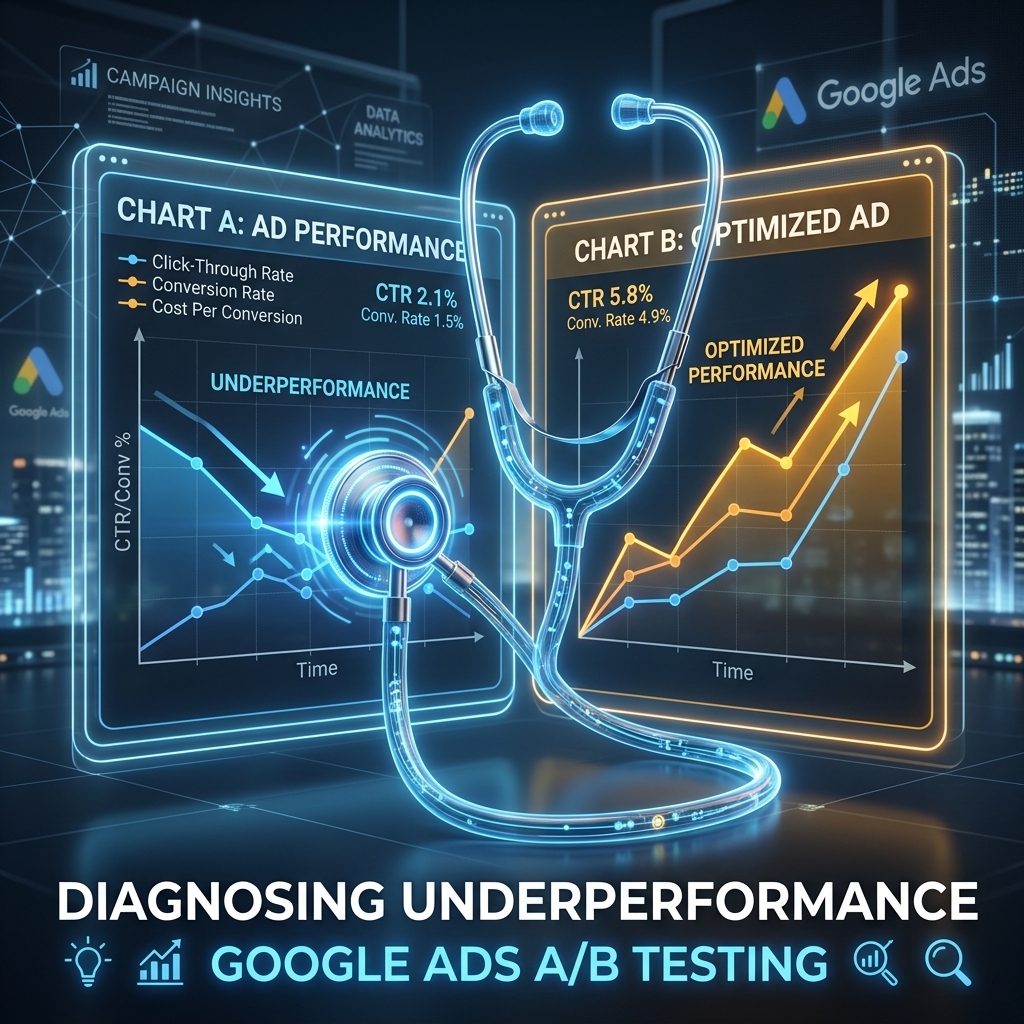
Google Ads A/B testing diagnoses underperformance by systematically comparing variations of campaign elements to identify optimal configurations. A/B testing, also known as split testing, involves running two or more versions of an ad, landing page, or campaign setting simultaneously to determine which performs better against a specific metric like click-through rate (CTR) or conversion rate. The outcome is a data-backed understanding of what elements drive conversions, allowing advertisers to eliminate underperforming assets and focus resources on winners. I’ve seen campaigns struggling with a 1.2% conversion rate jump to 3.5% simply by identifying and removing underperforming ad copy through focused A/B tests. This diagnostic approach pinpoints weak links, from ineffective headlines to misaligned bidding strategies, providing clear direction for optimization. Understanding why something isn’t working is the first step; next, we need to know how to set up these diagnostic tests effectively.
Setting Up Effective Google Ads Experiments
Setting up effective Google Ads experiments requires precise configuration to ensure valid and actionable results. Google Ads experiments allow you to create a draft of your campaign and then apply it as an experiment, splitting traffic between your original campaign and the experiment variation. This mechanism ensures controlled testing, providing clear data on performance differences between your control and experiment groups. For instance, you can test a new bidding strategy against your existing one, or evaluate the impact of a different audience segment by allocating a percentage of your campaign traffic to the experimental version.
When initiating a Google Ads experiment, define your hypothesis clearly: “Changing X will lead to Y outcome.” Select a single variable to test at a time to isolate its impact. For example, testing two different headline structures or two distinct bidding strategies should be done in separate experiments. Advertisers using a verified Google Ads agency account from AdShift can often initiate complex experiments with greater ease and manage concurrent tests without immediate spending limitations, which can be critical for rapid iteration and scaling. A robust agency ad account provides the necessary infrastructure for extensive split testing Google Ads campaigns. With the setup understood, the next crucial step is determining what specific elements within your ads to test for maximum impact.

Critical Elements for Google Ads Creative Testing
Critical elements for Google Ads creative testing include headlines, descriptions, ad extensions, and landing page variations. Creative testing in Google Ads focuses on isolating and evaluating different components of your ad assets to see which combinations resonate most with your target audience. The outcome is improved click-through rates (CTR), higher Quality Scores, and ultimately, better conversion performance. For search ads, I prioritize testing headline variations that convey different value propositions or calls-to-action. We often see a 15-20% uplift in CTR when a more specific, benefit-driven headline is chosen over a generic one. For display ads, image and video creative testing is paramount, with a recent client achieving a 30% lower CPA by iterating on video length and callout text.
Beyond ad copy, testing different ad extensions (e.g., sitelinks, callouts, structured snippets) can significantly impact ad real estate and user engagement. Even subtle changes in a call-to-action button color or text on a landing page, tested via a Google Ads experiment, can yield substantial conversion rate improvements. For a comprehensive understanding of all Google Ads components ripe for testing, refer to our complete guide on Google Ads strategies. Once these creative elements are put to the test, the real work begins in meticulously analyzing the split testing Google Ads data to extract meaningful insights.

Analyzing Split Testing Google Ads Results for Actionable Insights
Analyzing split testing Google Ads results for actionable insights demands a focus on statistical significance and key performance indicators (KPIs). Data analysis in A/B testing involves comparing the performance metrics (e.g., CTR, conversion rate, cost per acquisition – CPA) of your control and experiment groups. The outcome is a clear decision on which variation to implement permanently, backed by statistically significant evidence, not just anecdotal observations. Our campaigns show that an experiment should ideally run until it reaches statistical significance, typically requiring hundreds or thousands of conversions, before a definitive winner is declared. Prematurely stopping an experiment can lead to false positives and suboptimal decisions, costing advertisers valuable budget and opportunity.
Utilize Google Ads’ built-in experiment reporting to compare metrics side-by-side, paying close attention to the confidence levels it provides. A 95% confidence level or higher is generally accepted as statistically significant. If your experiment shows a clear winner with high confidence and positive impact on your primary KPI (e.g., lower CPA or higher conversion rate), then you can confidently apply the changes from the experiment to your original campaign. Identifying the winning elements is just one part; the next challenge is consistently scaling these improvements across your entire Google Ads strategy through continuous optimization.

Scaling Performance Through Continuous Google Ads A/B Testing
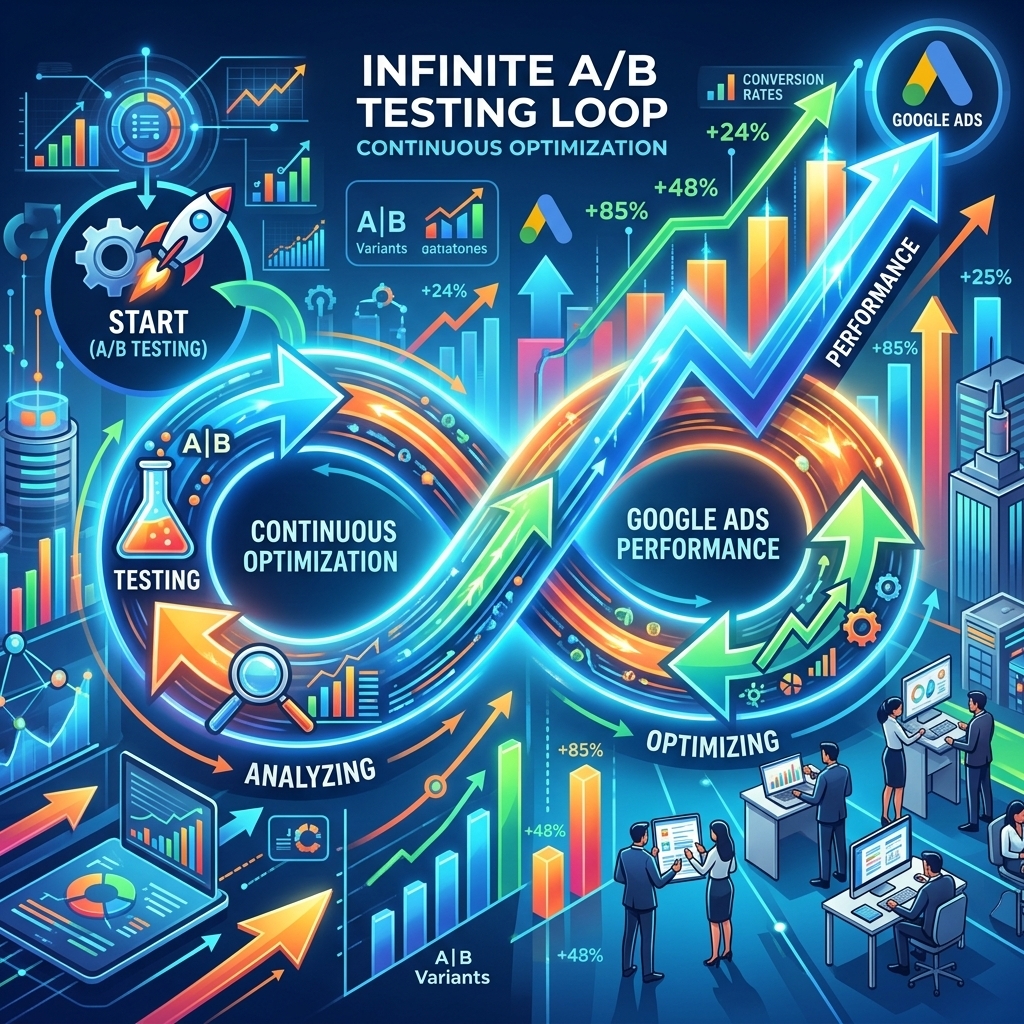
Scaling performance through continuous Google Ads A/B testing ensures long-term campaign efficacy and sustained growth. Continuous A/B testing involves making iterative improvements based on experiment results, then immediately setting up new tests to push performance further. This systematic approach to optimization prevents stagnation and capitalizes on every marginal gain, ensuring your campaigns remain competitive and efficient. For example, if an experiment reveals that a specific headline drives a 20% higher CTR, that winning headline becomes the new control. You then launch a new experiment testing different descriptions or ad extensions against this improved baseline.
A client recently achieved a 42% reduction in their target CPA over six months by implementing a rigorous cycle of ad copy testing, bid strategy experiments, and landing page variations. Each winning experiment became the new control, providing a higher baseline for the next test. This commitment to ongoing Google Ads A/B testing not only optimizes current campaigns but also builds a valuable library of insights about your audience, products, and effective messaging. It transforms your Google Ads strategy from a static setup into a dynamic, learning system that continuously adapts and improves.
FAQ
How long should a Google Ads A/B test run?
A Google Ads A/B test should run until it achieves statistical significance, which depends on traffic volume and conversion rates. Typically, this means gathering enough data for hundreds of conversions, often taking 2-4 weeks. Ending too early risks invalid results, leading to suboptimal campaign decisions. The goal is to collect enough data to confidently determine if the observed performance difference between variations is due to the change tested, rather than random chance.
What’s the difference between a Google Ads Experiment and an Ad Variation?
Google Ads Experiments allow you to test changes to entire campaign settings (bid strategies, audiences, ad groups, landing pages) by splitting campaign traffic. This provides a broad scope for testing fundamental campaign shifts. Ad Variations, are specifically for testing different versions of ad text within an existing campaign, primarily focusing on headlines and descriptions, without altering core campaign settings. Ad Variations are simpler and quicker for granular ad copy tests.
Can I A/B test landing pages within Google Ads?
Yes, you can A/B test landing pages using Google Ads experiments. You would set up an experiment where the control campaign points to one landing page URL, and the experiment variation points to another. This allows you to directly measure the impact of different landing page designs or content on conversion rates and other key performance indicators (KPIs) like bounce rate or average session duration. This is a powerful way to optimize the post-click experience.
What is a good split percentage for Google Ads A/B testing?
A common split percentage for Google Ads A/B testing is 50/50, ensuring an equal distribution of traffic and data collection for both the control and experiment variations. This provides the fastest path to statistical significance. For higher-risk tests or campaigns with very high volume, a 20/80 or 30/70 split (with less traffic to the experiment) can be used to mitigate potential negative impact while still gathering valuable data, albeit at a slower pace.
Conclusion
Mastering Google Ads A/B testing is not merely an optimization tactic; it’s a fundamental shift towards a data-driven, high-performance advertising strategy. By systematically diagnosing underperformance, setting up precise experiments, rigorously testing creative elements, and analyzing results for statistical significance, you unlock continuous improvement. This iterative process allows you to scale your campaigns efficiently, preventing wasted spend and maximizing ROI. Embrace Google Ads A/B testing to transform your campaigns from guesswork into a predictable engine for growth.
Ready to implement advanced Google Ads A/B testing strategies without the typical account limitations? Rent a verified Google Ads agency account from AdShift and unlock higher spending limits and expedited approvals for your experiments.