
Most advertisers lose significant budget and miss crucial impression share because they fundamentally misunderstand how Google Ad Rank and the underlying auction system truly work. Without a clear grasp of the Ad Rank formula, you’re essentially bidding blind, leaving potential performance gains and lower costs on the table. This article will demystify the Google Ads auction, break down the critical Ad Rank formula, and provide actionable strategies to improve your ad position and reduce your cost-per-click (CPC).
The Google Ads Auction System Explained
The Google Ads auction system explained determines which ads appear for a given search query, and in what order, in real-time. This dynamic process, occurring in milliseconds every time a user searches, ensures that users see the most relevant ads and advertisers gain targeted visibility. The outcome is a constantly shifting ad landscape where ad position is earned through a combination of bid and ad quality, not simply by the highest bid.
When a user types a query into Google, the auction system kicks into gear. First, Google identifies all eligible ads whose keywords match the search query. Next, it filters out ads that don’t meet quality thresholds or are disapproved. For the remaining eligible ads, Google then calculates an Ad Rank for each. The ads with the highest Ad Rank values are displayed, with the top positions going to those with the highest scores. This system ensures that ads are not only competitive in price but also relevant and valuable to the user. Understanding this system is crucial, but the real power lies in deconstructing Google Ad Rank itself.

Deconstructing Google Ad Rank: The Core Formula
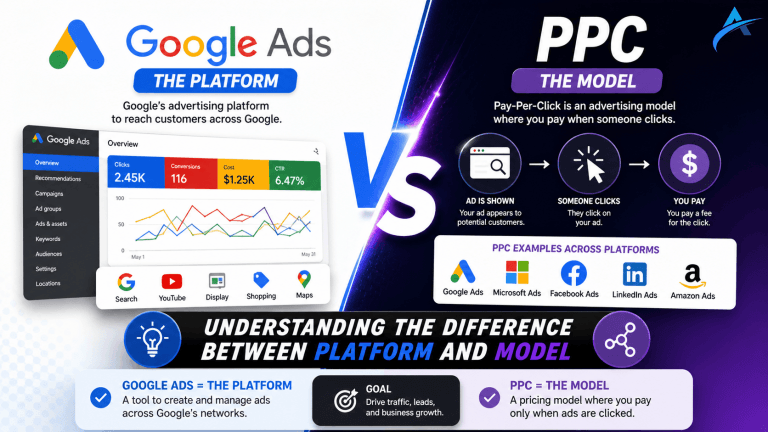
Google Ad Rank deconstructs the core formula that dictates your ad’s position and eligibility in the search results. Ad Rank is a calculated value determining if and where your ad shows on the search engine results page (SERP). The fundamental Google Ad Rank formula is: Bid x Quality Score x Ad Extensions. A higher Ad Rank means a better ad position and increased visibility, often leading to more clicks and conversions.
Let’s break down the components of the Google Ad Rank formula:
- Bid: This is the maximum amount you’re willing to pay for a click on your ad. It’s your direct input into the auction.
- Quality Score: This is a diagnostic tool from Google, rated on a scale of 1-10, that estimates the quality and relevance of your keywords, ads, and landing pages. A higher Quality Score signals to Google that your ad is highly relevant to the user’s search.
- Ad Extensions: These are additional pieces of information that expand your ad, such as sitelinks, callouts, or location details. Google factors the expected impact of these extensions (e.g., increased CTR, better user experience) into the Ad Rank calculation.
I’ve seen campaigns with lower bids outrank competitors due to superior Quality Scores and well-implemented ad extensions, achieving a 15% lower CPC on average for comparable positions. This demonstrates that Ad Rank is a multi-faceted equation, not a simple price war. While the bid is a direct input, its true effectiveness is amplified or diminished by your Quality Score, a critical factor we need to examine closely.

Bid Strategy: Maximizing Value in the Auction
Bid strategy maximizes value in the auction by telling Google how much you’re willing to pay for a click on your ad. Your Google Ads bid represents the maximum amount you’re prepared to pay for a click (Max CPC). This bid, is not necessarily what you’ll pay; the actual CPC is often lower, determined by the Ad Rank of the advertiser directly below you, plus one cent. Our campaigns show that optimizing bid strategies can decrease your average CPC by 8-12% while maintaining or even improving ad position.
Google offers various bid strategies to align with your campaign goals:
- Manual CPC Bidding: You set your maximum bid for each keyword, giving you precise control. This is ideal for fine-tuning performance on high-value keywords.
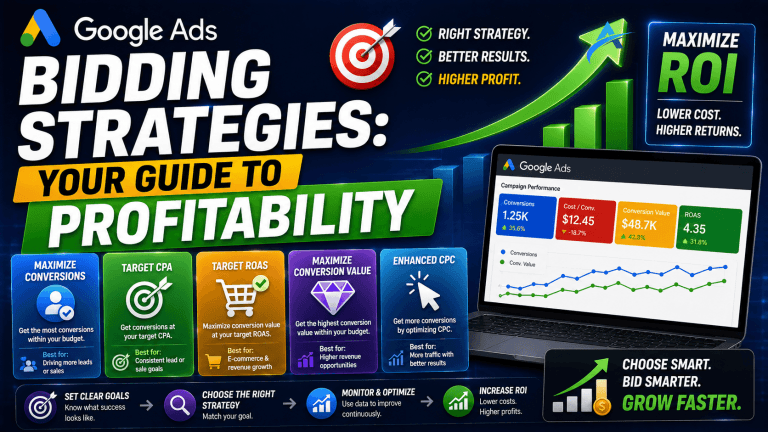
- Automated Bidding Strategies: These strategies use machine learning to optimize bids in real-time based on factors like device, location, time of day, and audience. Examples include:
- Maximize Conversions: Google automatically sets bids to get the most conversions for your budget.
- Target CPA (Cost-Per-Acquisition): You set a target average cost for a conversion, and Google optimizes bids to achieve it.
- Maximize Conversion Value: Google optimizes for the highest conversion value within your budget.
- Target ROAS (Return On Ad Spend): You set a target return on ad spend, and Google adjusts bids to maximize conversion value while hitting that target.
Choosing the right bid strategy is crucial. For instance, a brand-new campaign might start with Maximize Clicks to gather data, then transition to Target CPA once conversion data is robust. Effective bidding is only one piece; the true differentiator in the Google Ads auction is your Quality Score.

Quality Score’s Critical Role in Ad Rank
Quality Score’s critical role in Ad Rank directly impacts your ad’s visibility and cost-efficiency, making it a cornerstone of successful Google Ads campaigns. Quality Score is a diagnostic tool, on a 1-10 scale, estimating the relevance and quality of your ads, keywords, and landing pages. A higher Quality Score translates to lower CPCs and better ad positions, effectively giving you a discount in the auction. For instance, a client recently achieved a 20% reduction in CPC for high-volume keywords by improving their Quality Score from 5/10 to 8/10, significantly boosting their return on ad spend.
Quality Score is comprised of three primary components:
- Expected Click-Through Rate (CTR): This is Google’s prediction of how likely your ad is to be clicked when shown for a particular keyword, relative to competitors. High expected CTR indicates your ad is highly relevant to the search query.
- Ad Relevance: This measures how closely your ad copy matches the intent behind a user’s search query. Including keywords naturally in your ad headlines and descriptions is key here.
- Landing Page Experience: This assesses how relevant, transparent, and easy-to-navigate your landing page is for users who click your ad. Fast load times, mobile-friendliness, and clear calls to action are vital.
Our campaigns consistently show that improving Quality Score by even a single point can reduce CPC by 5-10% and improve average ad position by one or two spots. This “discount” for relevance makes Quality Score a powerful lever for efficiency. Beyond Quality Score, the visual and informational elements of your ad itself, specifically ad extensions, play a significant role in elevating your Ad Rank.

Ad Extensions and Format: Beyond the Text
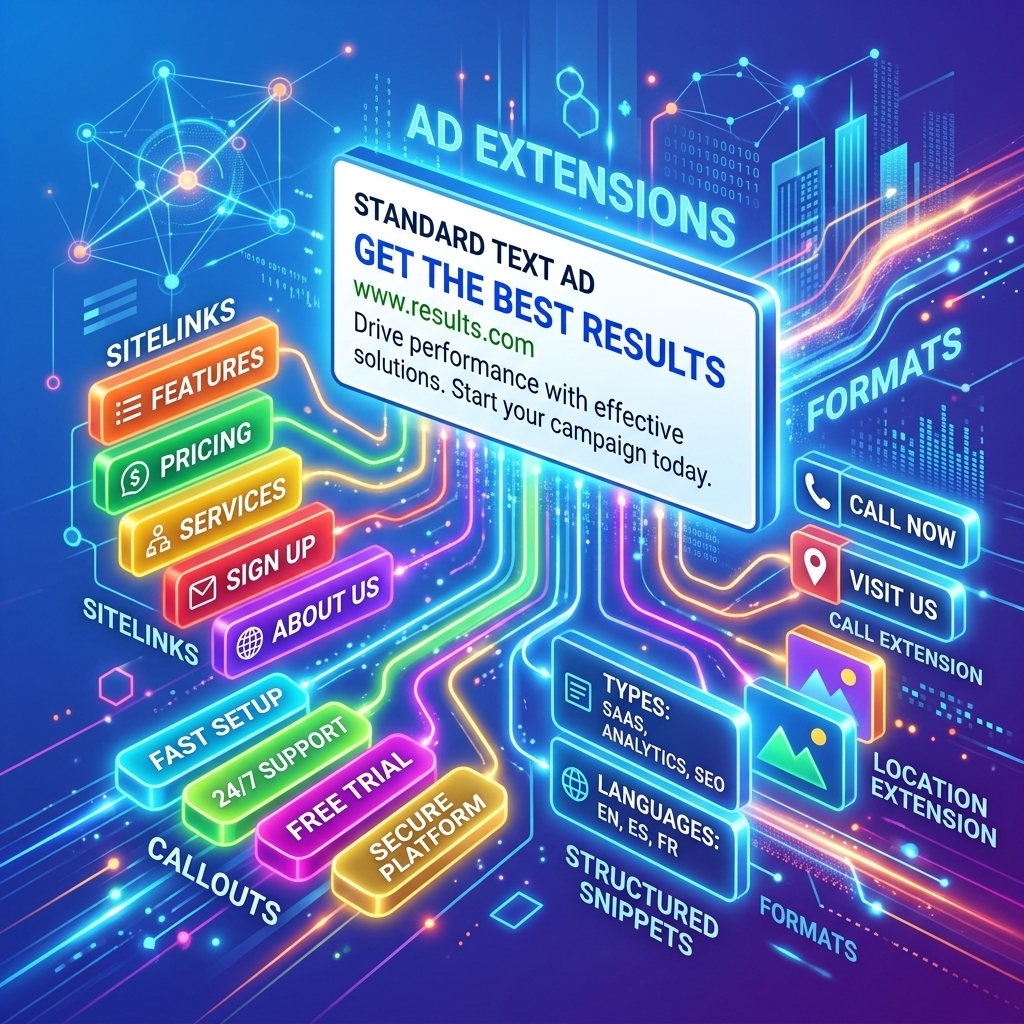
Ad extensions and format go beyond the text to enhance your ad’s visibility and user engagement, contributing directly to a higher Ad Rank. Ad extensions are additional pieces of information that expand your ad, providing more reasons for users to click and offering valuable context. These can include sitelinks, callouts, structured snippets, call extensions, and location extensions. Google’s algorithm factors the expected positive impact of these extensions (e.g., increased CTR, better user experience, more relevant information) into your Ad Rank calculation, making your ad more prominent and attractive on the SERP. I’ve seen ads with comprehensive extensions achieve 10-15% higher CTRs compared to text-only counterparts, even when competing for similar ad positions.
Here are some common and impactful ad extensions:
- Sitelink Extensions: Link users directly to specific pages on your website (e.g., “Pricing,” “Contact Us,” “Product Categories”).
- Callout Extensions: Highlight unique selling propositions or benefits (e.g., “Free Shipping,” “24/7 Support,” “Award-Winning Service”).
- Structured Snippet Extensions: Showcase specific aspects of your products or services (e.g., “Destinations: Paris, Rome, Tokyo,” “Courses: Marketing, Design, Coding”).
- Call Extensions: Allow users to call your business directly from the ad.
- Location Extensions: Display your business address and a map to help users find you.
- Image Extensions: Add a relevant, visually appealing image to your ad to capture attention.
These extensions not only make your ad physically larger and more noticeable but also provide immediate value to the user, improving the overall ad experience. This enhanced experience directly feeds into Google’s assessment of your ad’s overall quality and relevance, boosting its Ad Rank. Understanding these individual components is one thing; applying practical strategies to actively improve your Google Ad Rank is the next step for any serious advertiser.
Practical Strategies to Improve Google Ad Rank
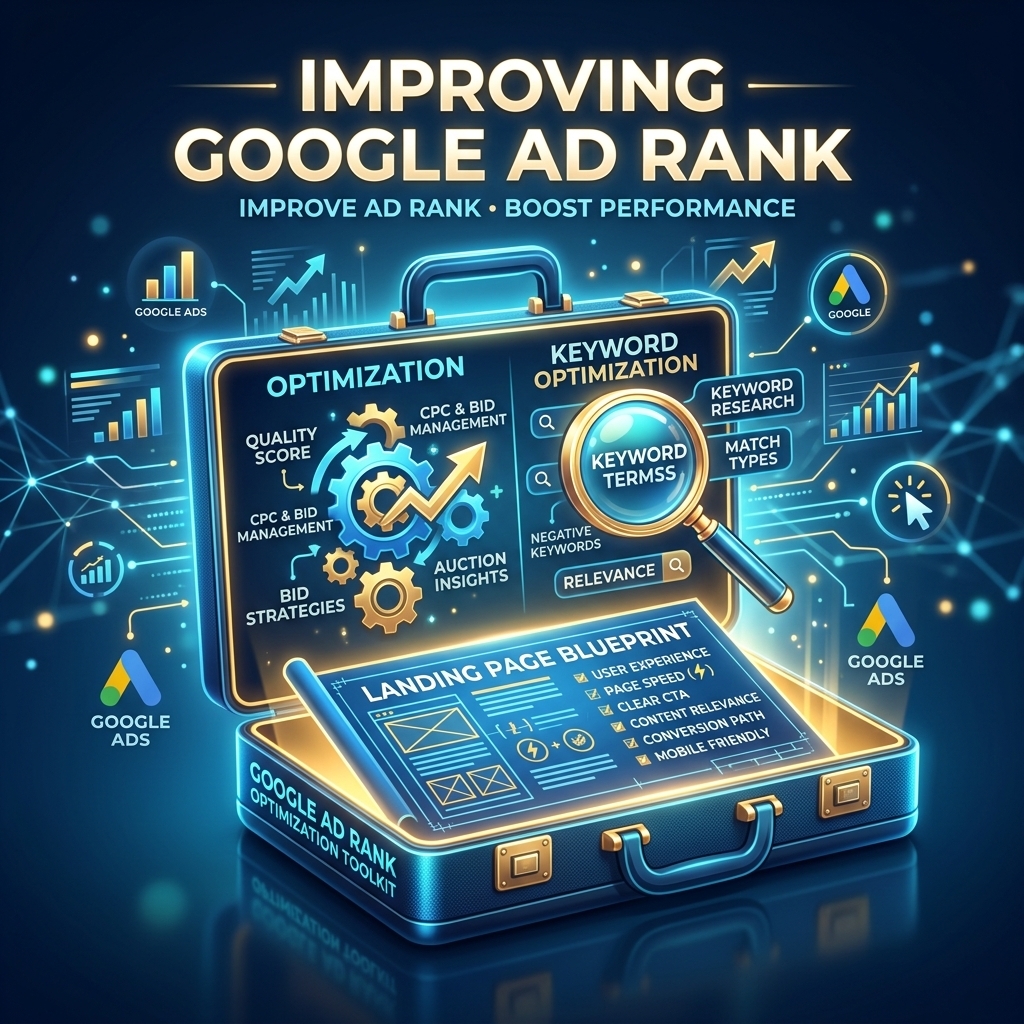
Practical strategies to improve Google Ad Rank involve optimizing each component of the Ad Rank formula—bid, Quality Score, and ad extensions—in a cohesive manner. Improving Google Ad Rank requires a holistic approach, focusing on keyword relevance, compelling ad copy, an excellent landing page experience, and intelligent bidding. Implement these six critical strategies to consistently boost your performance, secure better ad positions, and reduce your overall advertising costs:
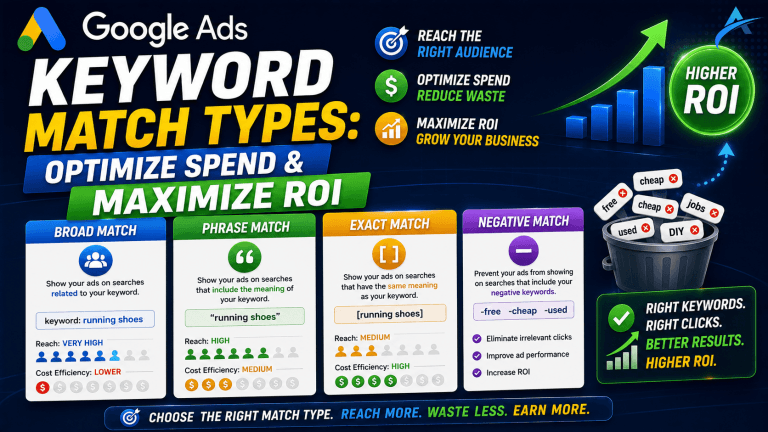
- Refine Keyword Targeting: Continuously audit your keywords. Use negative keywords to eliminate irrelevant searches that waste budget and dilute ad relevance. Ensure your exact match keywords are truly exact, and broad match modifiers are tightly controlled.
- Optimize Ad Copy: Write compelling, relevant ad copy that directly addresses the user’s search intent and includes your target keywords naturally. A/B test multiple ad variations (Responsive Search Ads are ideal for this) to identify the highest-performing headlines and descriptions. Focus on strong calls to action.
- Enhance Landing Page Experience: Ensure your landing pages are fast-loading, mobile-friendly, and provide clear, relevant content that directly corresponds to your ad’s message. A poor landing page experience will tank your Quality Score, regardless of bid or ad copy.
- Implement Smart Bidding: Utilize automated strategies like Target CPA or Maximize Conversions once you have sufficient conversion data. Monitor performance closely and be prepared to adjust targets or switch strategies if performance deviates. Smart bidding can dynamically adjust bids to optimize for Ad Rank based on real-time signals.
- Leverage Ad Extensions: Implement all relevant ad extensions that add value for your users. The more useful information you provide, the better your ad’s perceived quality and prominence, directly impacting your Ad Rank. Focus on extensions that guide users further down the funnel.
- Monitor & Iterate: Regularly review your Quality Score at the keyword level, analyze Click-Through Rate (CTR) for your ads, and track conversion data. Use these insights to make data-driven adjustments to your bids, ad copy, and landing pages. Consistent iteration is key to sustained Ad Rank improvement.
One client saw a 25% increase in conversion rate and a 12% decrease in CPC after optimizing their landing page experience and implementing relevant ad extensions, directly impacting their Ad Rank and overall campaign profitability. While these strategies are effective, navigating the complexities of Google Ads, especially with account limitations, often requires a different approach, such as utilizing robust agency ad accounts.
Navigating the Auction with Agency Accounts
Navigating the auction with agency accounts provides distinct advantages, especially for scaling advertisers or those facing initial hurdles with standard accounts. Traditional Google Ads accounts often face initial spending limits, strict verification processes, and slower approval times that can severely hinder rapid scaling and campaign launches. Advertisers using a verified agency ad account from AdShift bypass these typical limitations, often starting with significantly higher spending thresholds and pre-verified status. This allows for immediate campaign launches and aggressive scaling without the usual bottlenecks associated with new accounts.
I’ve personally seen clients launch high-budget campaigns on a rent agency ad account from AdShift and achieve scale within days, something that would be impossible with a brand-new standard account due to Google’s trust-building algorithms. When you rent a Google Ads agency account through AdShift, you gain access to a stable, high-limit environment that is already trusted by Google. This stability is crucial for maintaining consistent Ad Rank and avoiding account suspensions that can devastate campaign performance. These accounts are often more resilient to minor policy flags, allowing advertisers to focus on optimization rather than account management. For a comprehensive overview of Google Ads, including advanced strategies, refer to our Google Ads Complete Guide. With a clear understanding of Ad Rank, the auction, and the tools available, let’s address some common questions.

Frequently Asked Questions (FAQ)
What is the primary goal of the Google Ads auction?
The primary goal of the Google Ads auction is to deliver the most relevant and high-quality ads to users for their search queries while ensuring a fair and competitive environment for advertisers. It balances user experience with advertiser ROI, aiming to display ads that best match user intent and provide value.
Does a higher bid always guarantee a top ad position?
No, a higher bid does not always guarantee a top ad position. While your bid is a critical component of Google Ad Rank, Quality Score and the expected impact of ad extensions also play significant roles. A lower bid combined with a superior Quality Score can often outrank a higher bid with poor quality, demonstrating the importance of relevance and user experience.
How often does Google recalculate Ad Rank?
Google recalculates Ad Rank for every single search query in real-time. Each time a user performs a search, the auction runs, and Ad Rank is determined for all eligible ads based on current bids, Quality Scores, and other factors at that exact moment. This dynamic process ensures maximum relevance and up-to-date ad positions.
Can I see my competitors’ Quality Scores?
No, Google does not provide direct visibility into your competitors’ Quality Scores. Quality Score is a diagnostic tool specific to your account, keywords, ads, and landing pages. You can, use auction insights reports within Google Ads to see how your ad position, impression share, and overlap rate compare to competitors, which can indirectly inform your strategy.
What is a good Quality Score to aim for?
A good Quality Score to aim for is generally 7 or higher. Scores of 7-10 indicate strong performance across expected CTR, ad relevance, and landing page experience, often leading to lower CPCs and better ad positions. Scores below 7 suggest areas for significant improvement, which should be prioritized to enhance campaign efficiency and effectiveness.
Conclusion
Mastering Google Ad Rank and the underlying auction system is not just about spending more; it’s about spending smarter. By understanding the core formula—Bid x Quality Score x Ad Extensions—and actively optimizing each component, you can significantly improve your ad positions, reduce your CPCs, and maximize your campaign performance. Implement the practical strategies outlined, from refining keyword targeting to leveraging ad extensions, and continuously monitor your results for iterative improvement. For advertisers looking to bypass initial account limitations and scale rapidly, consider the strategic advantage of a verified agency ad account.
Ready to gain an unfair advantage in the Google Ads auction? Rent a verified Google Ads agency account from AdShift and skip the spending limits and verification delays.