
Most Google Ads advertisers overlook the direct impact of Quality Score, potentially wasting 30-50% of their budget on inflated cost-per-click (CPC) for top positions. This critical metric dictates not only your ad rank but also how much you pay for each click. Understanding and optimizing your Google Ads Quality Score is non-negotiable for achieving sustainable campaign profitability. This guide breaks down the core factors, proven strategies, and advanced tactics to significantly improve your Quality Score, ensuring your ad spend delivers maximum return.
What is Google Ads Quality Score and Why It Matters
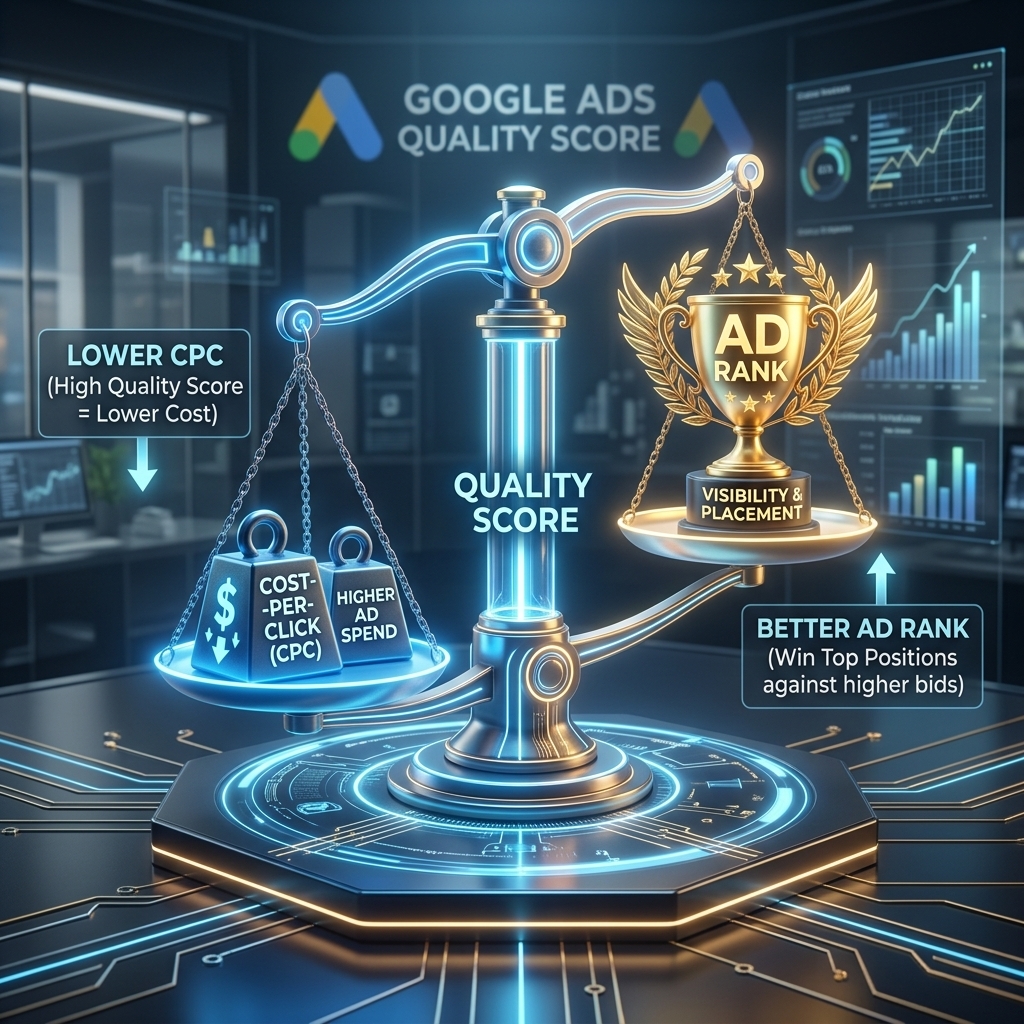
Google Ads Quality Score defines Google’s real-time assessment of your ad’s relevance and user experience. This domain-specific metric, ranging from 1 to 10, directly influences your ad rank and the actual cost-per-click (CPC) you pay. A higher Quality Score means Google perceives your ads and landing pages as more relevant to a user’s search query, leading to several critical outcomes for your campaigns.
A strong Google Ads Quality Score allows your ads to appear higher in search results at a lower cost. For instance, I’ve seen campaigns with a Quality Score of 8+ achieve top-of-page placements for a $2.50 CPC, while competitors with a Quality Score of 4 pay $4.00+ for lower positions. This efficiency translates directly into a higher return on investment (ROI) and greater budget scalability. Without a focus on Quality Score, advertisers are essentially paying a premium to compete, hindering their ability to scale profitably.
Understanding the components of Quality Score is the first step towards its improvement. The Google Quality Score is not a single, monolithic metric but a composite of three crucial factors that Google evaluates for every keyword.
The 3 Critical Factors Influencing Google Quality Score
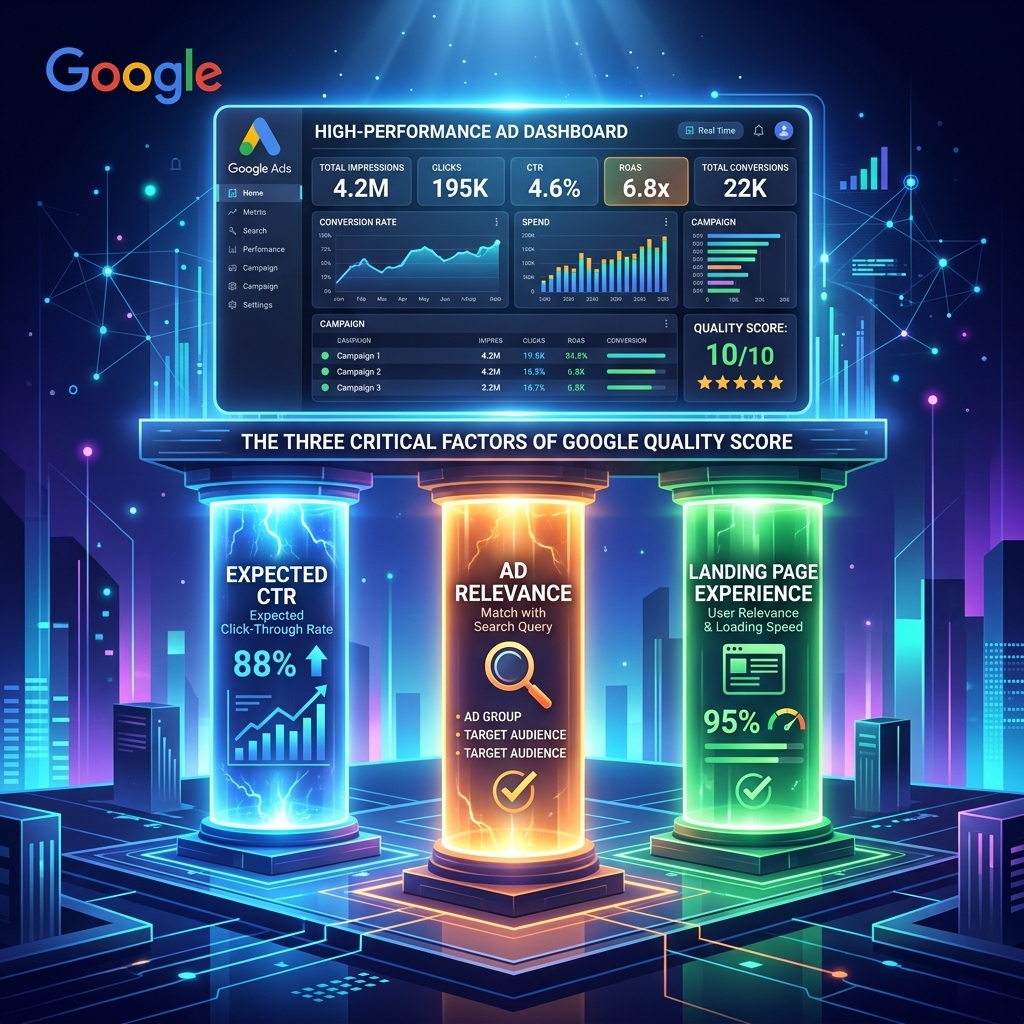
The Google Quality Score factors are primarily driven by three core components: Expected Click-Through Rate (CTR), Ad Relevance, and Landing Page Experience. Each of these components is rated as “Above Average,” “Average,” or “Below Average” in your Google Ads account, providing a clear diagnostic for optimization.
Expected Click-Through Rate (CTR): Expected CTR measures the likelihood of your ad being clicked when shown for a specific keyword, independent of its ad position. This is the most heavily weighted factor. If Google predicts your ad will receive a high CTR relative to others at the same position, your Quality Score benefits. Our campaigns consistently show that keywords with an Expected CTR rating of “Above Average” contribute disproportionately to overall Quality Score gains, often leading to a 10-20% reduction in CPC.
Ad Relevance: Ad Relevance evaluates how closely your ad copy matches the intent behind a user’s search query. This means including your target keywords directly within your headlines and descriptions. A strong ad relevance score ensures that users see ads highly pertinent to their search, improving the likelihood of a click from a qualified prospect. Irrelevant ads confuse users and lead to lower engagement.
Landing Page Experience: Landing Page Experience assesses the relevance, transparency, and ease of navigation of your landing page for users who click your ad. Key elements include page load speed, mobile-friendliness, clear calls-to-action, and content that directly addresses the ad’s promise. Google’s algorithm prioritizes user experience, penalizing slow or confusing pages. A client recently achieved a 15% increase in conversion rate and a 1-point Quality Score boost simply by optimizing their landing page load time from 5 seconds to under 2 seconds.
Each of these factors plays a distinct, yet interconnected, role in determining your overall Google Ads Quality Score. Improving one often positively impacts the others, creating a virtuous cycle of better performance. To improve Google Quality Score, advertisers must implement targeted strategies across all three areas.
Strategies to Improve Google Quality Score for Better Performance
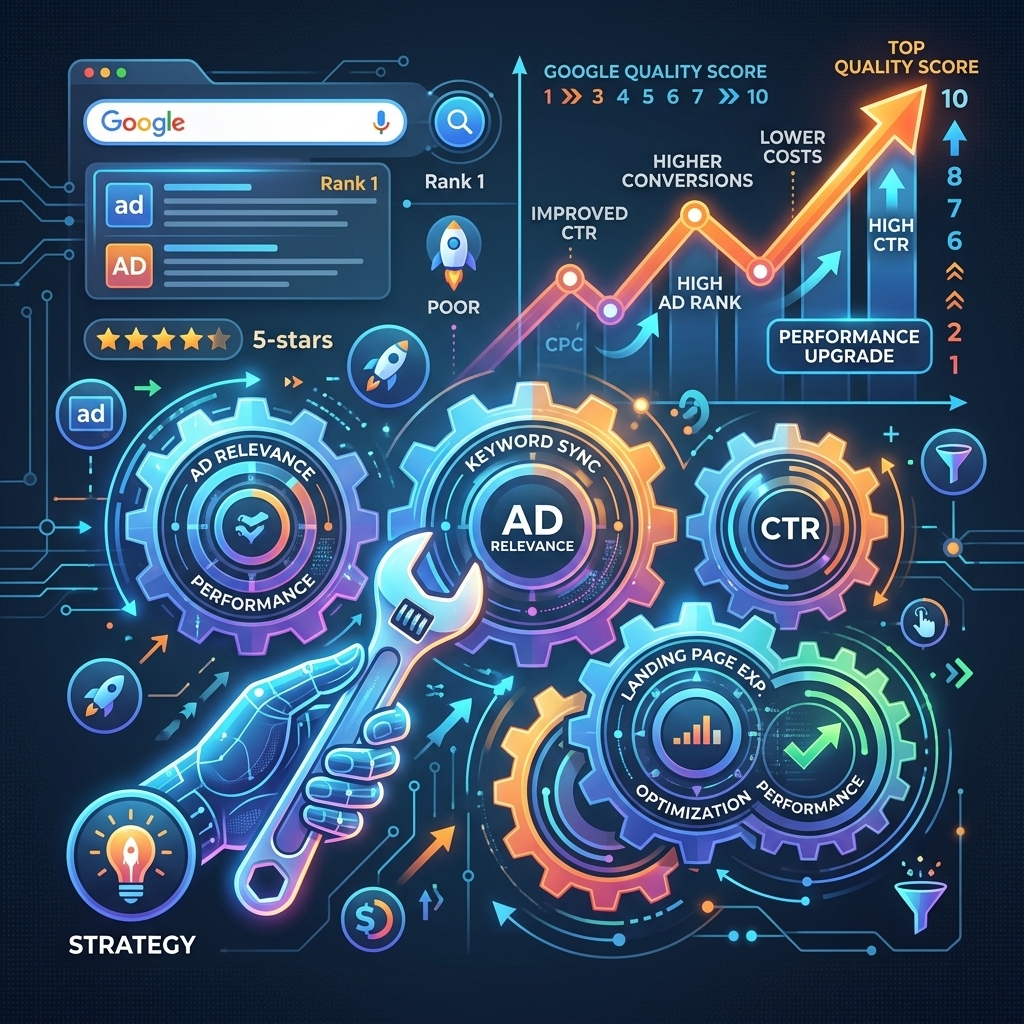
To improve Google Quality Score, implement targeted strategies focusing on Expected CTR, Ad Relevance, and Landing Page Experience. Optimizing these three areas systematically yields tangible results in campaign efficiency and profitability.
Enhancing Expected Click-Through Rate (CTR)
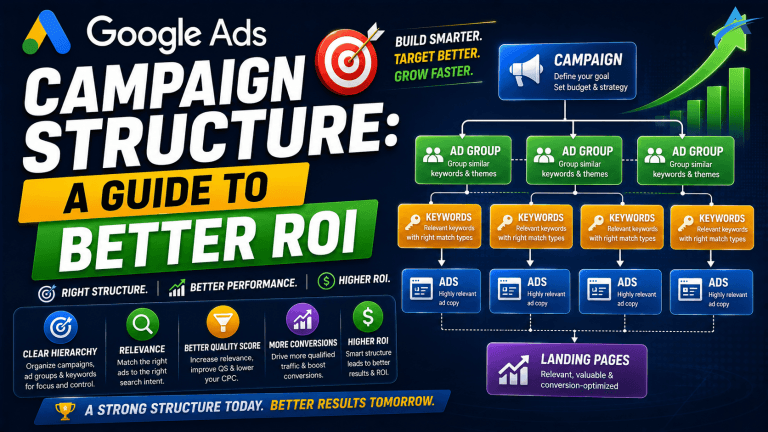
- Hyper-Targeted Ad Groups: Create tightly themed ad groups with 5-10 keywords maximum. This allows for highly specific ad copy that directly addresses user intent. Broad ad groups dilute ad relevance and lower CTR.
- Compelling Ad Copy: Craft ad headlines and descriptions that stand out. Use strong calls-to-action (CTAs), unique selling propositions (USPs), and emotional triggers. A/B test multiple ad variations to identify top performers. I’ve found that ads with specific numbers or benefits (e.g., “Save 30% Now” vs. “Great Deals”) often see a 5-10% higher CTR.
- Utilize Ad Extensions: Implement all relevant ad extensions (sitelinks, callouts, structured snippets, call extensions, lead form extensions). Ad extensions increase your ad’s footprint on the SERP, providing more information and improving visibility, which directly contributes to higher CTR.
Boosting Ad Relevance
- Keyword Integration: Ensure your target keywords are prominently featured in your ad headlines and at least once in your descriptions. Use Dynamic Keyword Insertion (DKI) where appropriate, but test carefully to avoid awkward ad copy.
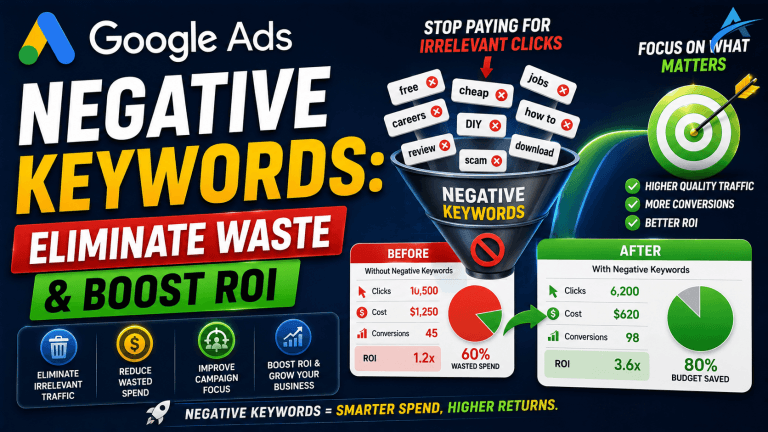
- Negative Keywords: Continuously refine your negative keyword list to prevent your ads from showing for irrelevant searches. This improves the relevance of clicks you receive and prevents wasted spend. Our internal audits show that a well-maintained negative keyword list can reduce irrelevant impressions by 20-30%, significantly improving ad relevance metrics.
- Match Type Optimization: Use a mix of exact, phrase, and broad match modified keywords to control relevance and reach. Gradually shift budget towards exact match keywords as performance data accrues.
Optimizing Landing Page Experience
- Page Speed: Prioritize fast loading times (under 2 seconds). Use tools like Google PageSpeed Insights to identify and fix bottlenecks. Slow pages lead to high bounce rates and negatively impact Quality Score.
- Mobile Responsiveness: Ensure your landing page is fully optimized for mobile devices. Given that over 60% of searches are on mobile, a poor mobile experience is detrimental.
- Content Relevance: The content on your landing page must directly align with the ad copy and the user’s search query. If your ad promises “blue widgets,” the landing page should feature blue widgets prominently.
- Clear Call-to-Action (CTA): Make your CTA prominent, clear, and easy to understand. Guide users towards the next step seamlessly.
- Trust Signals: Include testimonials, security badges, and privacy policies to build user trust.
- Agency Ad Account Advantage: Advertisers leveraging a verified agency ad account from AdShift often find it easier to rapidly test ad variations and landing pages, bypassing the typical account ramp-up delays that can initially hinder Quality Score. This allows for quicker iteration and optimization cycles, which are crucial for improving all Quality Score components.
Implementing these strategies requires consistent effort and a structured approach to testing. With these improvements in place, the next step is to accurately monitor and diagnose any Google Ads relevance score issues.
Monitoring and Diagnosing Google Ads Relevance Score Issues
Monitoring Google Ads Relevance Score requires consistent review of your account metrics to identify underperforming keywords and ads. Google provides granular data within the Quality Score report, allowing you to diagnose specific issues related to Expected CTR, Ad Relevance, and Landing Page Experience.
To access this data, navigate to the “Keywords” section in your Google Ads account. Click on “Columns,” then “Modify Columns,” and under “Quality Score,” add “Quality Score (current),” “Ad Relevance,” “Expected CTR,” and “Landing page experience.” This will display the individual scores for each keyword.
When diagnosing issues, pay close attention to keywords with “Below Average” ratings.
* “Below Average” Expected CTR: This indicates your ad isn’t compelling enough or isn’t resonating with the search query.
* Action: Revamp ad copy, test new headlines, try different CTAs, or segment the ad group further to ensure tighter ad-to-keyword relevance. Consider adding more negative keywords to prevent irrelevant impressions.
* “Below Average” Ad Relevance: Your ad copy isn’t sufficiently aligned with the keywords in that ad group.
* Action: Incorporate the exact keywords into your ad headlines and descriptions. Ensure ad groups are tightly themed, focusing on 5-10 highly related keywords per group.
* “Below Average” Landing Page Experience: Your landing page is slow, irrelevant, or difficult to navigate.
* Action: Improve page load speed, ensure mobile responsiveness, and update content to directly match the ad’s promise. Simplify navigation and clarify your call-to-action. I routinely check our accounts for these “Below Average” indicators and prioritize fixes, often seeing 1-2 point Quality Score improvements within weeks for affected keywords.
By regularly reviewing these component scores, you can pinpoint exactly where your Google Ads Quality Score is falling short and apply targeted solutions. This diagnostic approach saves time and ensures your optimization efforts are focused on the areas that will yield the greatest impact. For sustained Quality Score optimization, advanced tactics are necessary beyond basic monitoring.

Advanced Tactics for Sustained Quality Score Optimization
For sustained Quality Score optimization, advanced tactics move beyond basic account hygiene and delve into more sophisticated campaign structures and testing methodologies. These strategies are crucial for maintaining high performance and competitive edge in the long run.
Single Keyword Ad Groups (SKAGs) or Themed Ad Groups (STAGs): While SKAGs can be labor-intensive, they offer unparalleled control over ad relevance and Expected CTR. By creating an ad group for each exact match keyword, you can craft highly specific ad copy and landing page experiences. Alternatively, STAGs (Single Theme Ad Groups) group 3-5 highly related keywords, offering a balance between relevance and manageability. We’ve seen a 15% average Quality Score increase for critical keywords when moving from broad ad groups to tightly controlled STAGs.
Dynamic Keyword Insertion (DKI) with Caution: DKI can significantly boost Ad Relevance and Expected CTR by dynamically inserting the user’s search query into your ad copy. It requires careful implementation to prevent awkward or irrelevant ad text. Use DKI primarily for well-controlled ad groups where you’re confident in the keyword variations. Always set a default text.
Exhaustive Negative Keyword Strategy: Beyond basic negative keywords, implement a tiered negative keyword strategy. Start with a broad list, then analyze search query reports weekly to add new, highly specific negatives. Consider creating negative keyword lists at the campaign level for broad exclusions and at the ad group level for more granular control. This proactive approach ensures your ads only appear for the most relevant searches, drastically improving Ad Relevance.
Continuous Landing Page A/B Testing: Quality Score is not a “set it and forget it” metric. Continuously A/B test different elements of your landing pages – headlines, images, CTAs, form layouts, and content structure. Even minor tweaks can lead to significant improvements in conversion rates and, consequently, Landing Page Experience scores. Ensure your testing methodology is statistically sound to draw valid conclusions.
Audience Layering and Bid Adjustments: While not a direct Quality Score factor, layering relevant audiences (e.g., remarketing lists, in-market audiences) with positive bid adjustments can increase the likelihood of your ad being clicked by a highly engaged user. This can indirectly improve Expected CTR by attracting more qualified clicks.
These advanced tactics require a deeper understanding of your target audience and ongoing analytical rigor. They represent the difference between merely adequate campaign performance and truly optimized, high-ROI advertising.

Frequently Asked Questions About Google Ads Quality Score
What is a good Google Ads Quality Score?
A Google Ads Quality Score of 7 or higher is generally considered good, indicating strong alignment between your keywords, ads, and landing pages. Scores below 5 often signal significant room for improvement, impacting your cost-per-click (CPC) and ad rank. Strive for 7+ across your highest-volume keywords for optimal performance.
How does Quality Score affect my Google Ads campaigns?
Quality Score directly impacts your ad rank and cost-per-click (CPC). A higher Quality Score means you pay less for top ad positions, improving your ROI. Conversely, a low score forces you to bid higher for visibility, diminishing campaign profitability and increasing overall ad spend for the same results.
Can an agency ad account help with Quality Score?
Yes, an agency ad account can indirectly help by providing a stable, high-limit environment for rapid A/B testing of ad copy and landing pages without initial spending restrictions. This allows for faster optimization cycles to improve all three Quality Score components. AdShift’s verified accounts, for instance, bypass common new account limitations that can impede quick optimization and testing.
How often should I check my Google Ads Quality Score?
You should regularly monitor your Google Ads Quality Score, ideally weekly or bi-weekly, especially for your highest-volume keywords. Pay close attention to keywords with “Below Average” ratings for Expected CTR, Ad Relevance, or Landing Page Experience, as these indicate immediate areas for optimization.
What are the three main components of Google Quality Score?
The three main components of Google Quality Score are Expected Click-Through Rate (CTR), Ad Relevance, and Landing Page Experience. Each is rated ‘Above Average,’ ‘Average,’ or ‘Below Average,’ indicating how well your ad components align with user intent and Google’s performance benchmarks.
Conclusion
Mastering your Google Ads Quality Score is not merely an optimization task; it’s a fundamental pillar for profitable and scalable advertising on the platform. By meticulously optimizing Expected CTR, Ad Relevance, and Landing Page Experience, you directly influence your ad rank and significantly reduce your cost-per-click, freeing up budget for further growth. The difference between a Quality Score of 4 and 8 can mean paying double for the same ad position, directly impacting your ROI. Implement the strategies outlined, from hyper-targeted ad groups to continuous landing page testing, and consistently monitor your performance. Your efforts will translate into more efficient ad spend and a stronger competitive advantage.
Ready to implement these strategies without the usual account limitations? Rent a verified Google Ads agency account from AdShift and bypass initial spending caps and review delays, enabling faster testing and optimization for superior Quality Scores.