
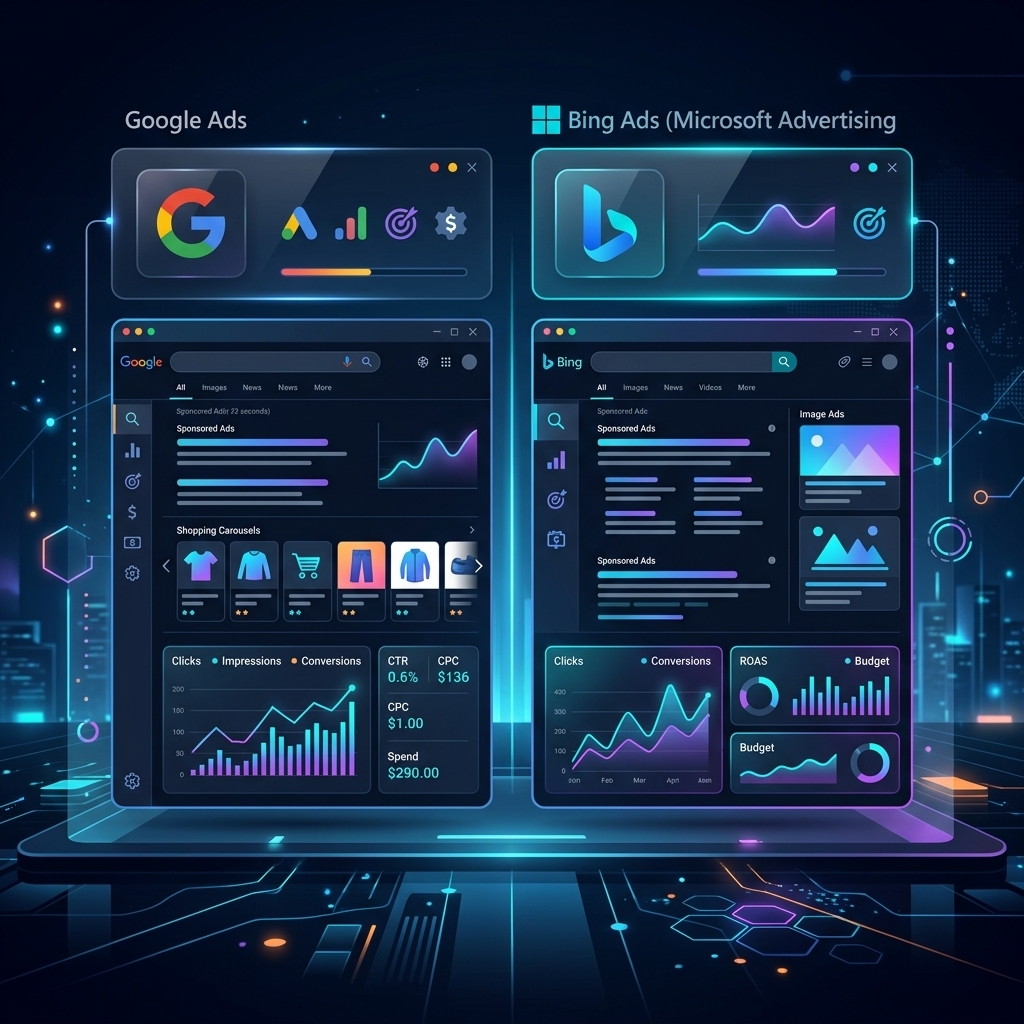
Bing Ads (Microsoft Advertising) delivers 30-40% lower CPCs than Google Ads across most verticals. Google commands 92% of global search market share. The platforms are not competitors — they are complementary channels that serve different audience segments at different price points.
Google Ads vs Bing Ads at a Glance
| Metric | Google Ads | Bing Ads (Microsoft Advertising) |
|---|---|---|
| Average CPC | Higher (baseline) | 30-40% lower |
| CPC Gap | 242% higher (Tower Marketing) | Baseline |
| Market Share | ~92% global search | ~3-4% global, ~33% US desktop |
| Monthly Users | 8.5B+ daily searches | 1B+ monthly searches |
| Device Skew | Mobile-heavy | Desktop-heavy |
| Demographics | Younger, broader | Older (35-65), higher income |
| Competition | High (saturated) | Lower (fewer advertisers) |
| B2B Targeting | Standard options | LinkedIn profile integration |
| Conversion Rate | ~1% higher than Bing | Slightly lower |
| Search Network | Google Search, YouTube, Maps, Gmail | Bing, Yahoo, AOL, DuckDuckGo, Ecosia |
| Campaign Import | N/A | One-click import from Google Ads |
Market Share and Audience Reach
Google dominates with 92% of global search traffic. That number makes Bing’s 3-4% global share look insignificant — until you look at the actual volume.
Bing processes over 1 billion monthly searches. In the US desktop market, Bing holds approximately 33% market share. That is not a niche. That is a third of all desktop searches in the largest advertising market in the world.
Bing’s reach extends beyond bing.com. Microsoft Advertising serves ads across Yahoo Search, AOL, DuckDuckGo, and Ecosia. The Microsoft Search Network reaches users who actively avoid Google — a segment you miss entirely if you advertise only on Google.
Many advertisers overlook Bing because of the global market share number. That is a strategic mistake. Less advertiser competition means lower CPCs and higher ad positions for the same budget.

Cost Comparison
| Cost Metric | Google Ads | Bing Ads |
|---|---|---|
| Relative CPC | Baseline (100%) | 60-70% of Google |
| CPC Multiplier | 242% higher (Tower Marketing) | Baseline |
| Competition Level | High | Moderate to low |
| Avg Position for Same Bid | Lower (more competition) | Higher (less competition) |
Tower Marketing’s cross-platform analysis found Google Ads CPCs are 242% higher than Bing Ads for equivalent keywords. That is not a marginal difference.
Practical example: A keyword costing $8.00 CPC on Google might cost $3.30 on Bing. At 1,000 clicks per month, that is $8,000 on Google vs $3,300 on Bing — $4,700 in monthly savings.
Google’s ~1% higher conversion rate partially offsets the CPC gap. But for most advertisers, the CPC savings more than compensate for the slight conversion rate difference. The math favors running both platforms through an agency ad account to maximize reach while minimizing cost per acquisition.

Audience Demographics
Google’s audience skews younger, more mobile, and broader. Google captures the widest cross-section of internet users. If your target customer is 18-34 and primarily uses mobile devices, Google is your primary platform.
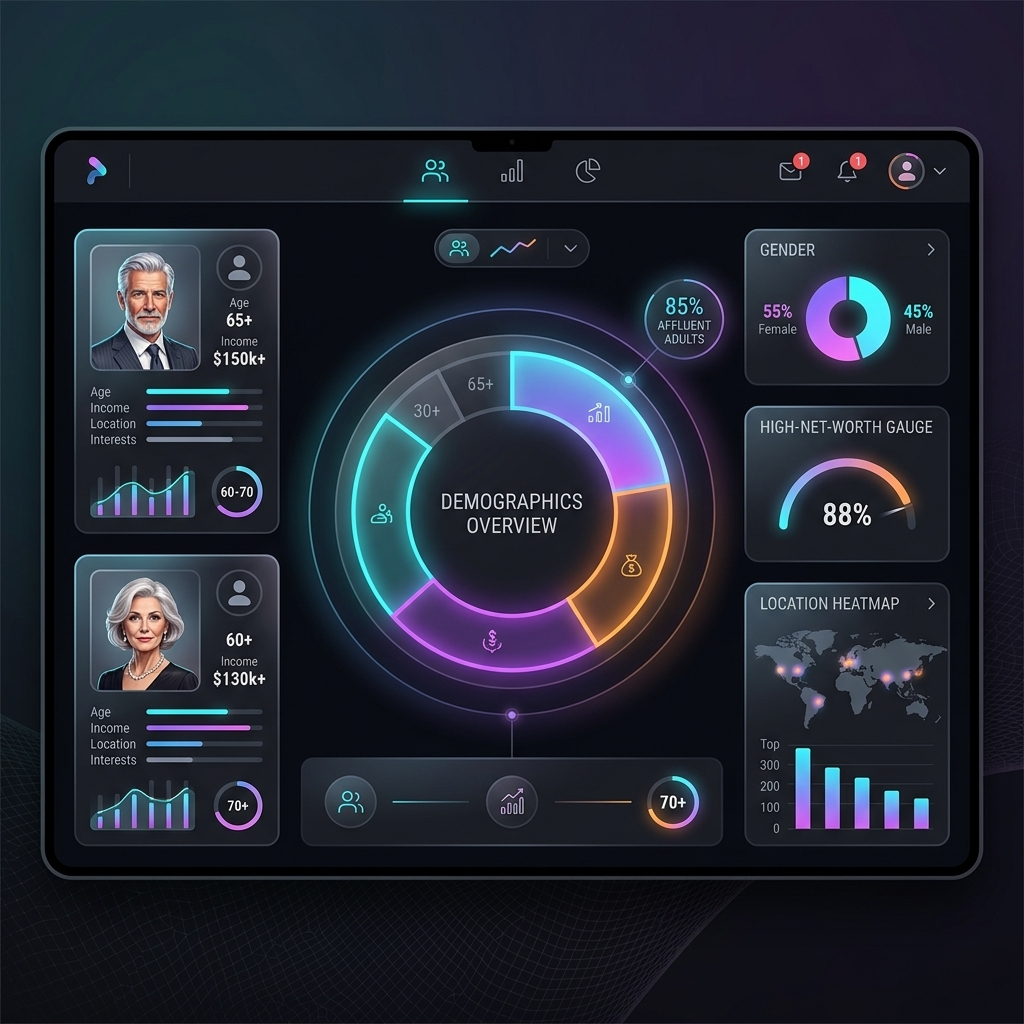
Bing’s audience skews older (35-65), uses desktop computers, and earns higher household income. This is not accidental — Bing is the default search engine on Windows, Microsoft Edge, and many corporate environments.
Why demographics matter for ad spend:
- Higher income users have more purchasing power per click.
- Desktop users convert at higher rates than mobile users for most B2B products.
- Older demographics are underserved by most digital advertisers — less competition for their attention.
- Corporate desktop users searching on Bing are often B2B decision-makers.
If your product targets professionals, B2B buyers, or consumers with above-average income, Bing’s demographic profile matches your ideal customer at a fraction of Google’s cost.
Targeting Features
Both platforms offer standard search advertising targeting: keywords, locations, devices, demographics, and ad scheduling. The critical differentiator is Bing’s LinkedIn integration.
Bing’s LinkedIn profile targeting lets you target ads based on:
- Company name
- Job function
- Industry
- Seniority level
No other search advertising platform offers this. Google has no equivalent. You can target “Marketing Directors at companies with 500+ employees in the SaaS industry” — on a search engine, at search intent CPCs. This is the single strongest B2B targeting feature in paid search.
Google’s targeting advantages:
- Larger remarketing audience pools (more site visitors use Google)
- In-market audiences with deeper purchase intent data
- Custom intent audiences based on search behavior
- YouTube audience integration for cross-platform targeting
For B2C advertisers, Google’s broader targeting options win. For B2B advertisers, Bing’s LinkedIn integration is unmatched.

Campaign Import
Bing offers one-click campaign import from Google Ads. Export your Google campaigns — keywords, ad copy, bid strategies, extensions — and import them directly into Microsoft Advertising.
What imports:
- Campaign and ad group structure
- Keywords and match types
- Ad copy and extensions
- Bid amounts (adjustable during import)
- Targeting settings
What to adjust after import:
- Reduce bids by 30-40% to match Bing’s lower CPC environment.
- Review audience targeting for Bing’s demographic differences.
- Add LinkedIn targeting for B2B campaigns.
- Adjust device bid modifiers (Bing skews desktop).
This import feature eliminates the setup barrier. You can launch a full Bing Ads campaign in under 30 minutes using your existing Google Ads structure. ADShift provides verified agency ad accounts for both Google and Bing, making cross-platform expansion seamless — one provider, two search networks, maximum coverage.

When to Choose Bing Ads
Your target audience is B2B. Bing’s LinkedIn targeting + desktop-heavy demographic = ideal B2B search advertising. Target decision-makers by job title and company size at 30-40% lower CPCs than Google.
Your audience skews older or higher income. Financial services, luxury goods, healthcare, insurance, and retirement planning all align with Bing’s demographic profile.
You want lower CPCs. If Google Ads CPCs are squeezing your margins, Bing offers the same search intent at significantly lower cost. The conversion rate difference is minor compared to the CPC savings.
You already run Google Ads. If Google Ads is profitable, Bing is incremental reach at lower cost with minimal setup effort. Import your campaigns, adjust bids, and capture the 33% of US desktop searchers you are currently missing.
Your competitors ignore Bing. Check your competitive keywords on Bing. If competitor ad density is low, you can dominate ad positions with smaller bids. Less competition = lower CPC + higher ad position + more impression share.
An agency ad account from ADShift gives you verified accounts on both platforms. Run Google for maximum reach. Run Bing for cost efficiency. Manage both through a single trusted provider.

FAQ
Is Bing Ads worth it with only 3-4% market share?
Yes. That 3-4% represents over 1 billion monthly searches. In the US desktop market, Bing holds 33% share. Lower competition means lower CPCs. Most advertisers who test Bing see positive ROI — the lower cost more than compensates for smaller volume.
Can I run the same campaigns on both Google and Bing?
Yes. Bing’s campaign import tool lets you copy your Google Ads campaigns directly. Adjust bids down 30-40% for Bing’s lower CPC environment and add LinkedIn targeting for B2B campaigns.
Which platform converts better?
Google Ads has roughly 1% higher conversion rates on average. But Bing’s 30-40% lower CPCs often produce lower cost per acquisition despite the conversion rate gap. Run both and compare CPA, not conversion rate.
Does Bing Ads work for ecommerce?
Yes. Bing Shopping campaigns work similarly to Google Shopping. Bing’s higher-income demographic can mean higher average order values. The lower CPC environment improves ROAS for many ecommerce advertisers.
What is Microsoft Advertising vs Bing Ads?
Same platform, different name. Microsoft rebranded “Bing Ads” to “Microsoft Advertising” in 2019. The product, features, and ad network remain the same.
Rent verified agency ad accounts for both Google and Bing from ADShift — maximize your search reach while minimizing cost per click. Get a Bing Ads account.